
Introduction
Students in India face critical academic decisions at every stage of their education. A secondary student might struggle with mathematics formulas. A senior secondary student must balance board exam syllabi with entrance tests. Later, school leavers must decide which degree to pursue and which college to attend.
Parents and students often feel overwhelmed by the sheer volume of choices. Advertisements frequently promise top ranks and guaranteed placements. However, every learner has unique strengths, study habits, and learning speeds.
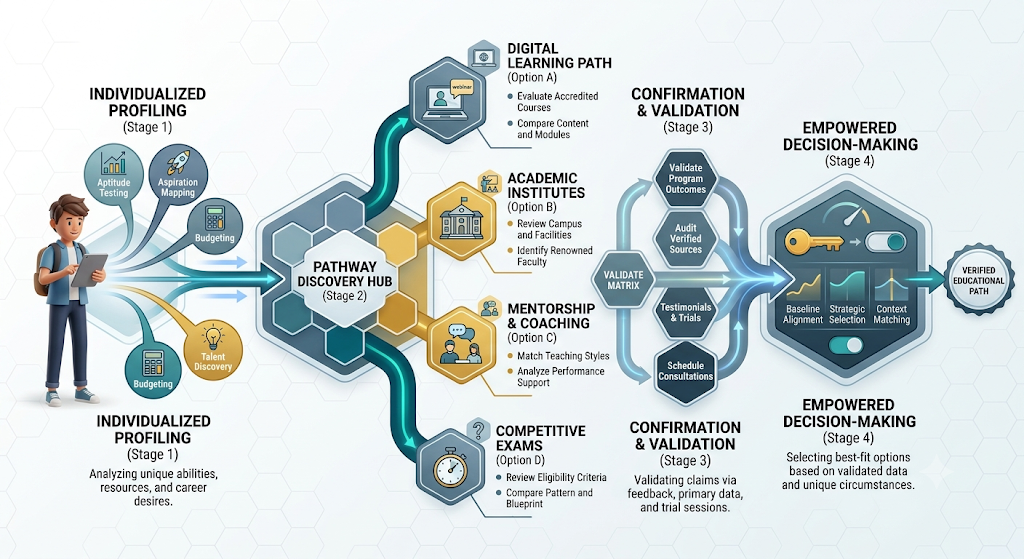
Making the right academic choice requires a structured approach. Instead of following general trends, students need clear criteria to evaluate private tutors, coaching institutes, and colleges. Clear facts make educational decisions easier and far more effective.
Private Tutoring: When and Why You Need It
School classrooms move at an average group pace. A single teacher often manages 40 to 60 students in one classroom session. Under these conditions, teachers cannot always pause to fix every individual learning gap.
Private tutoring bridges this gap by providing personal attention. A dedicated tutor helps you review difficult concepts, complete homework, and build study discipline.
       [Classroom Setting]                      [Private Tutoring]
  1 Teacher : 40-60 Students                1 Teacher : 1-5 Students
  • Fixed teaching pace                     • Personalized pace
  • General curriculum coverage             • Targeted doubt-clearing
  • Limited time per student                • Immediate feedback
Consider seeking a tutor when:
- You consistently score below your target in a specific subject.
- Basic concepts from earlier grades remain unclear.
- You need structured accountability for regular revision.
- You are preparing for advanced tests that school classes do not cover.
Finding and Evaluating Tutors Online and Locally
Students today can choose between home tutoring and digital classes. Both options offer clear benefits depending on your daily routine, location, and learning style.
Evaluating Online Tutors in India
When you find tutors online, you gain access to skilled subject specialists regardless of where you live. A student in a smaller district can easily learn from an experienced teacher based in a major academic hub.
Online learning also removes travel time. This saved time allows students to rest, revise, or pursue hobbies. To evaluate online tutors India, check:
- Subject Experience: Ask how many years the teacher has taught your specific board syllabus (such as CBSE, ICSE, or State Boards).
- Digital Tools: Check if the tutor uses interactive whiteboards, screen-sharing, and structured slide decks to make concepts clear.
- Session Structure: Confirm whether lessons include regular diagnostic tests and dedicated doubt-clearing sessions.
- Internet Stability: Ensure both you and the tutor have stable connections and backup options for class continuity.
Assessing In-Person Home Tutors Near You
If you prefer face-to-face interaction, using search tools to find tutors near me helps locate home educators in your neighborhood. In-person guidance often suits younger learners who need direct supervision to maintain focus.
When evaluating a local tutor, verify:
- Background and Qualifications: Check their degree certificates and subject background.
- Teaching Experience: Confirm their track record with your class level.
- Location and Travel Distance: Choose someone living nearby to prevent frequent cancellations caused by transit delays.
- Schedule Compatibility: Ensure the tutor’s available hours match your school and rest schedule.
| Evaluation Factor | Online Tutors | Local Home Tutors |
| Geographic Reach | Nationwide selection | Limited to local travel radius |
| Travel Time | Zero travel time | Requires local transit |
| Attention Format | Digital tools and screen sessions | Direct physical supervision |
| Scheduling Flexibility | High flexibility across time slots | Dependent on local travel windows |
Choosing the Right Coaching Institute
Coaching institutes play an important role in competitive test preparation and board support. When searching for coaching institutes near me, families encounter countless options ranging from neighborhood study circles to national coaching brands.
Avoid selecting a coaching institute based solely on marketing banners. Large hoardings often highlight a few top-performing students while hiding the average performance of the broader batch.
How to Evaluate a Coaching Institute:
1. Faculty Stability    ──> Are teachers permanent or frequently changing?
2. Batch Size           ──> Will the student get doubts answered?
3. Study Material       ──> Is the syllabus updated to current patterns?
4. Testing System       ──> Are test series accompanied by performance analysis?
5. Fee Transparency     ──> Are refund rules and total costs clear in writing?
Key Factors to Compare
- Faculty Stability: Inquire about the permanent teaching staff. Frequent teacher turnover during an academic year disrupts student learning.
- Batch Size: Institutes with 100 or more students per batch make individual questions difficult. Look for centres that maintain reasonable student-to-teacher ratios or run separate doubt sessions.
- Curriculum and Materials: Ask to view sample study material. The theory should be concise, and exercise questions must match recent exam patterns.
- Test Series and Feedback: Regular practice tests are necessary. Ensure the institute provides detailed performance analysis rather than just a total score.
- Fee Structure: Review the complete fee schedule, including registration fees, study material charges, taxes, and refund rules.
When researching the best coaching institutes in India, focus on structural support rather than celebrity endorsements. An institute with smaller batches, approachable teachers, and consistent test series will serve you better than a crowded center with famous branding.
Preparing for Competitive Exams in India
Clearing competitive exams in India requires a shift from rote memorization to concept application. School tests reward writing long answers from memory. Entrance tests, by contrast, test speed, conceptual precision, and elimination techniques under strict time limits.
Major Competitive Exams After 12th
Students completing senior secondary education can choose from several national and state entrance tests:
- Engineering: JEE Main serves as the gateway to NITs, IIITs, and CFTIs, while also qualifying candidates for JEE Advanced (for IIT admissions). State examinations such as MHT CET, WBJEE, and KCET provide entry into state engineering colleges.
- Medicine and Allied Sciences: NEET UG is the single national entrance exam for MBBS, BDS, AYUSH, and veterinary seats across India.
- Law: CLAT and AILET test legal aptitude, logical reasoning, and English proficiency for admission to National Law Universities.
- Central Universities and Degree Colleges: CUET UG allows students to apply to major central, state, and private universities using a single testing score.
- Defense Services: The NDA entrance examination, conducted by UPSC, recruits candidates for the Army, Navy, and Air Force wings of the National Defence Academy.
                Common Competitive Exam Pathways After Class 12
                                       │
         ┌──────────────────┬──────────┴──────────┬──────────────────┐
         ▼                  ▼                     ▼                  ▼
    Engineering          Medical                 Law            Universities
  (JEE Main/Adv)        (NEET UG)           (CLAT / AILET)       (CUET UG)
Building a Practical Preparation Strategy
Early, deliberate competitive exam preparation prevents last-minute stress. Adopt these proven study practices:
- Understand the Syllabus: Download the official syllabus directly from the organizing authority (such as NTA or UPSC). Mark topics you have mastered and topics you have not started.
- Master Foundational Textbooks: For science and mathematics examinations, NCERT textbooks remain essential. Finish these before moving to advanced problem collections.
- Solve Past Years’ Question Papers (PYQs): Practice with official papers from the past 5 to 10 years. This shows how questions are framed and which topics appear frequently.
- Take Timed Mock Tests: Sit for full-length practice tests at the exact hours of the real examination. This trains your concentration and builds time management skills.
- Maintain an Error Log: Note down every calculation slip, conceptual error, or missed question in a dedicated notebook. Review this notebook weekly.
College and Course Discovery
Selecting an undergraduate course and college directly influences your early career path. Many students pick an institution based only on brand name or peer recommendations. However, conducting a structured college search India ensures you choose an institution suited to your goals.
Essential Factors to Compare Colleges and Courses
When you compare colleges and courses, look past marketing brochures and analyze objective criteria:
- Accreditation and Recognition: Check whether the university has approvals from statutory authorities such as the UGC (University Grants Commission) or AICTE (All India Council for Technical Education). For general universities, check NAAC grading; for engineering programs, review NBA accreditation.
- Curriculum Relevance: Review the course syllabus on the institution’s official portal. Does the curriculum include practical lab work, elective choices, and industry-aligned skills?
- Faculty Credentials: Look at the faculty directory. Are professors full-time employees, and do they hold advanced research or industry experience?
- Campus Facilities: Adequate laboratories, stocked libraries, computer centers, and active project spaces are essential for applied learning.
- Verified Placement Records: Look for median salary numbers published in mandatory disclosure reports, such as the NIRF (National Institutional Ranking Framework) filings. Median figures reflect typical outcomes far more accurately than isolated peak packages.
| Institutional Factor | What to Verify | Why It Matters |
| Accreditation | UGC, AICTE, NAAC grade | Ensures your final degree is officially recognized |
| Curriculum | Electives, lab hours, modern tools | Ensures the syllabus prepares you for current industry needs |
| Median Salary | Mandatory public disclosures (NIRF) | Shows realistic starting outcomes for typical students |
| Batch Strength | Total annual student intake | Shows whether campus placement teams can support everyone |
Common Mistakes to Avoid in Education Planning
Students and parents often repeat avoidable mistakes when planning their academic paths:
- Following Peer Trends: Joining a coaching batch or choosing an engineering branch simply because friends did so often leads to burnout and poor academic performance.
- Relying Solely on Promotional Claims: Never trust unaudited marketing banners that claim “100% placement” or “guaranteed selection.” Always verify numbers through official documents.
- Ignoring Travel Fatigue: Choosing an institute two hours away from your home cuts into rest, self-study, and health.
- Skipping Self-Study Time: Coaching and tutoring only assist your learning; they do not replace it. If you spend eight hours in class, reserve at least two to three hours for solo revision.
- Postponing Doubt Resolution: Allowing questions to pile up creates confusion later. Clear doubts with your tutor or teacher as soon as they arise.
How GurukulGalaxy Simplifies Education Discovery
Searching for reliable education providers through general search engines often yields unverified classifieds, outdated blog posts, and aggressive sales landing pages.
GurukulGalaxy functions as an education discovery platform. It connects students and parents directly with verified learning resources across India. Instead of navigating confusing marketing claims, learners can research and compare educational options within one organized ecosystem:
                          GURUKULGALAXY PLATFORM
                                    │
    ┌────────────────┬──────────────┴───────────────┬────────────────┐
    ▼                ▼                              ▼                ▼
Tutor Discovery  Coaching Search             College Research   Exam Information
• Online Tutors  • Local Centers            • Course Details   • Pattern Updates
• Home Tutors    • Subject Specialists      • Affiliations     • Eligibility Criteria
- Tutor Discovery: Find qualified teachers by subject, grade level, curriculum, and preferred location. Whether you need an online instructor for advanced physics or a local teacher for primary school foundations, you can evaluate profiles and send direct inquiries.
- Coaching Search: Discover coaching institutes in your city or region. Compare course options, batch details, and student support services before visiting campuses.
- College and Course Exploration: Access organized information on degrees, eligibility rules, and institutional affiliations to make informed higher education choices.
- Competitive Exam Guidance: Stay informed about national entrance tests, syllabus updates, exam formats, and key registration timelines.
Practical Decision-Making Checklist
Before finalizing any tutor, coaching enrollment, or college application, run through this verification checklist:
- [ ] Have you confirmed the tutor’s or institution’s qualifications and subject credentials?
- [ ] Does the class or college schedule leave sufficient time for self-study and sleep?
- [ ] Are the total fees, installment schedules, and refund policies documented in writing?
- [ ] Have you reviewed the syllabus to ensure it matches your target examination or career goals?
- [ ] If choosing a college, have you checked its UGC, AICTE, or NAAC status on official portals?
- [ ] If selecting an online course, have you tested your internet speed and hardware setup?
FAQ Section
How can I find tutors online?
Students can find tutors by exploring education discovery platforms, checking subject credentials, confirming teaching experience with the specific syllabus, and attending an initial trial session.
What is the difference between private tutoring and coaching institutes?
Private tutoring offers one-on-one or small-group instruction tailored to your individual pace. Coaching institutes teach standardized syllabi to larger batches following fixed schedules.
How do I find tutors near me for home tuition?
Use trusted education discovery directories, specify your locality and subject, verify the teacher’s qualifications, and confirm their travel availability before starting classes.
What should I check before joining a coaching institute?
Evaluate the permanent faculty, average batch size, study material quality, regular testing systems, and clear fee refund rules.
Which competitive exams in India can students take after 12th?
Major exams include JEE Main and JEE Advanced for engineering, NEET UG for medical sciences, CLAT for law, and CUET UG for admissions to central and state universities.
How can students effectively compare colleges and courses?
Compare colleges by checking official UGC or AICTE approvals, NAAC grades, curriculum relevance, faculty credentials, campus labs, and median placement salaries reported in official NIRF filings.
Are online tutors in India as effective as offline tutors?
Yes, online tutors are effective if the student is disciplined and the teacher uses digital whiteboards, regular assessments, and clear explanations.
How does GurukulGalaxy help students and parents?
GurukulGalaxy is an education discovery platform that helps users find tutors, discover coaching institutes, research colleges, and check entrance exam details in one place.
When should a student start competitive exam preparation?
Most students begin preparing in Class 11 for national entrance tests like JEE and NEET. Starting two years in advance allows steady concept building and sufficient revision time.
Can I clear national competitive exams without coaching?
Yes. Many students clear competitive exams through disciplined self-study, NCERT textbooks, standard reference works, previous years’ papers, and online doubt support.
Conclusion: Building Your Education Roadmap
Navigating academic choices across school, competitive exams, and higher education does not require following crowd trends or paying for unverified promises. Sustainable success comes from identifying your specific learning needs, setting realistic timelines, and verifying the institutions you choose.
Whether you decide on a dedicated online tutor, an interactive coaching environment, or a specific undergraduate college, focus on verified quality and everyday fit. Education discovery platforms like GurukulGalaxy help remove the guesswork by organizing tutors, institutes, colleges, and exam resources into one transparent system. By researching carefully and sticking to structured self-study, students and parents can make confident academic decisions that deliver lasting results.

