
Introduction
In today’s fast-paced digital economy, organizations rarely rely on a single, isolated software tool to run their operations. Instead, business owners, startup founders, and technology leaders find themselves managing a diverse digital ecosystem. However, treating web development, cloud computing, and artificial intelligence as separate silos often creates operational friction, data bottlenecks, and escalating costs.
True digital transformation requires a connected strategy where web solutions, cloud infrastructure, and AI integration function as a cohesive unit. When web interfaces connect seamlessly with scalable cloud resources and intelligent automation, businesses can achieve higher efficiency, better user engagement, and sustainable scalability. This article explores how these three foundational pillars interact within modern enterprise environments, outlining practical frameworks for integration while examining how platforms like BHEEKHO.COM position themselves within this landscape.
Understanding the Role of Modern Web Solutions
A modern web presence extends far beyond a static online brochure. In a business context, web solutions encompass dynamic business websites, web applications, customer portals, and enterprise interfaces designed to engage users and streamline transactions.
Key aspects of modern web solutions include:
- Responsive Experiences: Ensuring consistent performance across mobile devices, tablets, and desktop computers.
- Performance and Speed: Optimizing load times to reduce bounce rates and improve user retention.
- Security Standards: Implementing robust data protection measures to safeguard user inputs and transactions.
- APIs and System Integration: Connecting frontend interfaces cleanly with backend databases and external services.
When web architecture is built with scalability and flexibility in mind, it forms a reliable foundation for capturing customer interactions and supporting day-to-day business processes.
Why Cloud Technology Has Become Important for Modern Businesses
Cloud technology has fundamentally shifted how organizations manage computing resources. Rather than investing heavily in physical servers, businesses leverage cloud infrastructure to rent storage, computing power, and networking capabilities on a flexible, pay-as-you-go model.
Major advantages of cloud computing include:
- Scalability: Instantly scaling resources up or down depending on traffic spikes or seasonal business demands.
- Reliability and Business Continuity: Built-in redundancy and automated backups protect organizations from unexpected hardware failures.
- Global Data Accessibility: Enabling distributed teams to collaborate securely from any location.
- Application Hosting: Deploying web applications and heavy workloads in secure, managed environments.
By moving infrastructure to the cloud, organizations eliminate physical maintenance overhead while ensuring their digital services remain accessible and resilient.
Understanding AI Integration in Business Technology
Artificial intelligence often conjures images of complex science fiction concepts, but in a practical business environment, AI integration focuses on solving specific operational problems. Rather than adopting AI simply because it is a market trend, forward-thinking companies integrate intelligent tools to optimize workflows and reduce manual friction.
Practical applications of business AI include:
- Automating Repetitive Tasks: Handling routine data entry, invoice sorting, or preliminary customer support inquiries.
- Data Analysis and Insights: Processing large datasets quickly to identify patterns, trends, and anomalies.
- Personalization: Tailoring product recommendations, content feeds, or user journeys based on individual behavior.
- Decision Support: Providing predictive insights that help managers make informed operational choices.
When implemented purposefully, AI acts as an extension of existing software infrastructure, enhancing human capability rather than replacing core business logic.
How Web Solutions, Cloud, and AI Work Together
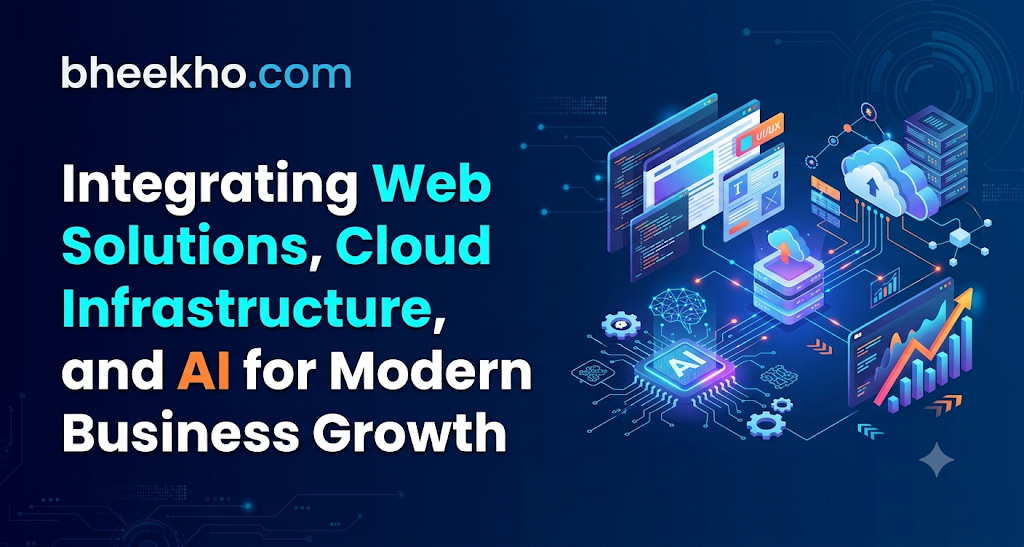
The true power of modern technology emerges when web solutions, cloud infrastructure, and AI integration operate as a connected ecosystem. Isolating these layers limits their effectiveness. When combined, they form a continuous loop:
$$\text{Web Layer (User Interface)} \longrightarrow \text{Cloud Infrastructure (Storage \& Compute)} \longrightarrow \text{AI Capabilities (Intelligence)} \longrightarrow \text{Business Value}$$
- The Web Layer: Users interact with a clean, responsive web application or portal to submit requests, search for products, or manage accounts.
- The Cloud Infrastructure: Backend APIs route these user requests securely through scalable cloud servers, ensuring fast response times and reliable data storage.
- The AI Capabilities: Integrated machine learning models or AI services process the data in real time—such as categorizing support tickets, generating automated responses, or predicting user preferences.
- The User Experience: The system delivers an intelligent, immediate result back through the web interface, completing the cycle.
How BHEEKHO.COM Approaches the Combination of Web, Cloud, and AI
Navigating the convergence of multiple technologies requires clear strategic planning. Platforms like BHEEKHO.COM operate within this space by offering structured digital services that encompass custom web applications, secure cloud deployments, and smart, AI-driven automation capabilities.
Rather than treating web development, infrastructure hosting, and intelligence features as isolated projects, a unified approach focuses on aligning technology execution with specific business requirements. By combining scalable web solutions with cloud environments and targeted AI enhancements, organizations can modernize their digital infrastructure without unnecessary architectural complexity.
Business Benefits of Combining Web, Cloud, and AI
Integrating web solutions, cloud infrastructure, and AI yields several compounding advantages for growing enterprises and established businesses alike:
- Greater Scalability: Cloud infrastructure easily accommodates the data growth generated by active web applications and AI models.
- Operational Efficiency: Automation reduces the time staff spend on repetitive administrative tasks.
- Enhanced Customer Experience: Users benefit from faster load times, personalized interactions, and 24/7 intelligent support options.
- Reduced Silos: Unified architectures ensure that marketing, IT, and customer service teams access consistent, real-time data.
Technology Integration Comparison Matrix
| Technology Component | Primary Operational Role | Core Business Benefit |
| Web Solutions | User-facing digital experience and interfaces | Accessibility, engagement, and conversion |
| Cloud Technology | Scalable infrastructure, hosting, and data storage | Flexibility, cost efficiency, and reliability |
| AI Integration | Intelligent automation and data processing | Smarter insights and reduced manual overhead |
| Integrated Approach | Connected digital ecosystem | Maximum agility and long-term readiness |
Practical Examples of Web + Cloud + AI Integration
To visualize how these technologies intersect, consider the following illustrative business scenarios:
- AI-Enhanced E-Commerce Platforms: An online retail website (web layer) hosted on flexible cloud servers utilizes integrated machine learning algorithms to recommend products based on browsing history, resulting in higher average order values.
- Automated Customer Support Portals: A customer service web portal backed by cloud infrastructure routes user inquiries through natural language processing tools, instantly resolving routine questions while escalating complex issues to human agents.
- Intelligent Business Dashboards: A cloud-based reporting application aggregates daily operational metrics from multiple web forms and applies predictive analytics to highlight potential supply chain delays before they impact operations.
How Businesses Can Build an Integrated Technology Strategy
Adopting an integrated technology model requires a methodical, step-by-step framework:
- Identify Business Problems: Determine specific operational bottlenecks or customer experience gaps that technology should solve.
- Evaluate Existing Web Infrastructure: Audit current websites and web applications to assess performance, security, and integration readiness.
- Identify Cloud Requirements: Determine storage, computing, and security needs to ensure reliable application hosting.
- Find Suitable AI Use Cases: Select targeted areas where automation or data analysis will provide measurable value.
- Plan APIs and System Integration: Ensure that frontend web components communicate smoothly with backend cloud databases and AI services.
- Address Security and Data Governance: Establish strict compliance protocols to protect sensitive customer and corporate data.
- Build, Test, and Deploy: Implement solutions in phases, conducting thorough testing across devices and load conditions.
- Monitor and Scale: Continuously track performance metrics and scale resources as business demand grows.
Web, Cloud, and AI Integration Challenges
While the benefits are significant, technology integration comes with notable challenges that organizations must proactively manage:
- Integration Complexity: Connecting legacy software with modern cloud APIs and AI models requires specialized technical oversight.
- Data Security and Privacy: Centralizing data across web and cloud environments increases the importance of robust encryption and access controls.
- Cost Management: Unmonitored cloud resource consumption or poorly optimized AI API calls can lead to unexpected expenses.
- Skills Gaps: Internal teams may require training or external consulting support to manage advanced cloud-native architectures.
Organizations can mitigate these risks by adopting modular implementation plans, conducting regular security audits, and partnering with experienced technology providers.
Choosing the Right Technology Partner
Selecting an external technology partner is a critical milestone for any digital transformation initiative. Decision-makers should evaluate potential partners against a rigorous set of criteria:
- Technical Expertise: Demonstrated capability across web development, cloud architecture, and AI deployment.
- Business Acumen: Ability to align technical solutions with core commercial objectives rather than focusing solely on features.
- Security Practices: Transparent adherence to data protection standards and secure coding guidelines.
- Scalability Mindset: Designing architectures that support long-term growth without requiring a complete rebuild.
- Support and Maintenance: Commitment to ongoing monitoring, updates, and system optimization.
BHEEKHO.COM and the Future of Integrated Digital Technology
As digital ecosystems continue to evolve, trends such as cloud-native development, API-first architecture, and practical intelligent automation will define market leaders. Businesses looking to future-proof their operations must look beyond isolated software upgrades and embrace unified strategies.
When evaluating service providers in this space, organizations often review platforms like BHEEKHO.COM to understand how their structured offerings in web solutions, cloud deployment, and AI integration can support specific growth initiatives. By focusing on practical execution and scalable foundations, companies can successfully navigate the complexities of modern digital transformation.
Comparison of Technology Maturity Stages
| Maturity Stage | Web Infrastructure | Cloud Usage | AI Integration | Operational Agility |
| Stage 1: Basic | Static informational site | None / Local hosting | None | Low; high manual effort |
| Stage 2: Transitional | Dynamic web application | Basic cloud storage | Basic rule-based scripts | Moderate; expanding digital presence |
| Stage 3: Advanced | Scalable web portals | Full cloud-native hosting | Active AI automation | High; efficient, connected ecosystem |
Web, Cloud & AI Integration Checklist for Businesses
☐ Define clear business objectives for technology modernization
☐ Audit existing web applications and frontend performance
☐ Assess cloud infrastructure and hosting requirements
☐ Identify high-impact AI automation opportunities
☐ Establish secure API integration protocols
☐ Review data privacy and compliance guidelines
☐ Evaluate long-term scalability and cost models
☐ Plan phased deployment schedules
☐ Conduct rigorous cross-device and load testing
☐ Establish continuous performance monitoring mechanisms
Frequently Asked Questions (FAQs)
1. What are web solutions in a business context?
Web solutions encompass custom websites, web applications, customer portals, and digital interfaces designed to engage users and support business workflows.
2. What is cloud integration?
Cloud integration involves connecting business applications, data storage, and computing workloads to flexible, remote cloud infrastructure for improved accessibility and scalability.
3. What does AI integration mean for organizations?
AI integration is the incorporation of machine learning models and intelligent automation into existing software systems to streamline tasks, analyze data, and personalize user experiences.
4. How do web, cloud, and AI work together?
Web applications serve as the user interface, cloud infrastructure provides scalable storage and computing power, and AI processes data to deliver intelligent automated results.
5. Why should businesses combine these technologies instead of adopting them separately?
Combining them eliminates operational silos, reduces data friction, and ensures that user experiences, backend resources, and automation work cohesively.
6. Can small businesses utilize cloud and AI technologies?
Yes. Flexible cloud pricing and accessible AI APIs allow small businesses and startups to leverage enterprise-grade capabilities without large upfront hardware investments.
7. Is AI integration expensive?
Costs vary depending on scope. Starting with targeted use cases—such as automated customer support or basic data categorization—keeps budgets manageable while delivering immediate ROI.
8. What are the main security concerns in web and cloud integration?
Key concerns include unauthorized data access, insecure API endpoints, and compliance vulnerabilities, which can be mitigated through robust encryption and regular audits.
9. How does cloud technology support AI applications?
AI models require substantial computing power and large datasets. Cloud infrastructure provides the scalable processing capacity necessary to train and run these models efficiently.
10. How can businesses start their digital transformation journey?
Begin by identifying core operational bottlenecks, auditing current IT assets, and partnering with experienced technology consultants to map out a phased implementation plan.
11. What should businesses look for in a technology partner?
Look for proven expertise across web development, cloud architecture, and AI deployment, alongside a strong commitment to security and business alignment.
12. How does BHEEKHO.COM assist with these technologies?
BHEEKHO.COM operates as a digital innovation hub, offering end-to-end services that cover custom web solutions, secure cloud deployments, and smart AI integration.
Conclusion
The convergence of web solutions, cloud infrastructure, and artificial intelligence represents a fundamental shift in how modern organizations build and scale their operations. Rather than functioning as separate silos, these three pillars are interdependent components of a single digital ecosystem. Responsive web interfaces capture user engagement, flexible cloud environments provide reliable storage and computing muscle, and targeted AI integration automates workflows to deliver intelligent insights.
By adopting a structured, phased implementation strategy and carefully evaluating potential technology partners, businesses can eliminate operational friction and future-proof their digital assets. Platforms like BHEEKHO.COM illustrate how unifying these capabilities empowers companies to navigate digital transformation smoothly, achieving sustainable agility and long-term market competitiveness in an evolving technological landscape.

