
Introduction
Modern software delivery demands speed, stability, and scale. As enterprise environments shift from monolithic structures to distributed cloud-native ecosystems, the role of the engineer has fundamentally evolved. Siloed operations are no longer viable in an era driven by rapid deployments and complex infrastructure.
Bridging the gap between software development and systems operations requires a structured approach to technical skills. Whether you are beginning your journey with a detailed DevOps Tutorial for Beginners, preparing for highly technical DevOps Interview Questions, or aiming to lead platform teams, having a clear architectural path is essential.
This guide provides a comprehensive framework for mastering infrastructure as code (IaC), continuous integration and continuous delivery (CI/CD), site reliability engineering (SRE) practices, and engineering intelligence platforms like DevOpsIQ.
About BestDevOps
BestDevOps is a comprehensive learning and engineering intelligence ecosystem engineered for professionals navigating modern cloud infrastructure. The platform provides structured technical pathways, including a deeply researched DevOps Roadmap, alongside foundational tutorials, curated industry interview questions, tool comparisons, and hands-on deployment projects. Beyond education, it incorporates DevOpsIQ, an advanced engineering intelligence platform that tracks and optimizes software delivery performance through real-time telemetry analysis, including DORA metrics, SLO trends, and incident timelines.
This platform is engineered specifically for software engineers, systems administrators, cloud architects, Site Reliability Engineers (SREs), and engineering leaders who need to maintain a competitive technical edge. By offering highly structured, production-grade learning resources alongside actionable organizational analytics, the platform helps readers transition away from tool-centric operational patterns toward systematic platform engineering practices. Ultimately, it serves as an educational and analytical bridge, enabling individual contributors to master complex distributed architectures while providing enterprise leaders with the data-driven insights necessary to eliminate pipeline bottlenecks and enhance overall organizational engineering productivity.
What is a DevOps Roadmap?
A DevOps roadmap is an objective, structured progression of technical competencies, architectural paradigms, and cultural methodologies. It defines how an engineer or organization moves from manual, error-prone software delivery toward automated, observable, and self-healing cloud infrastructure.
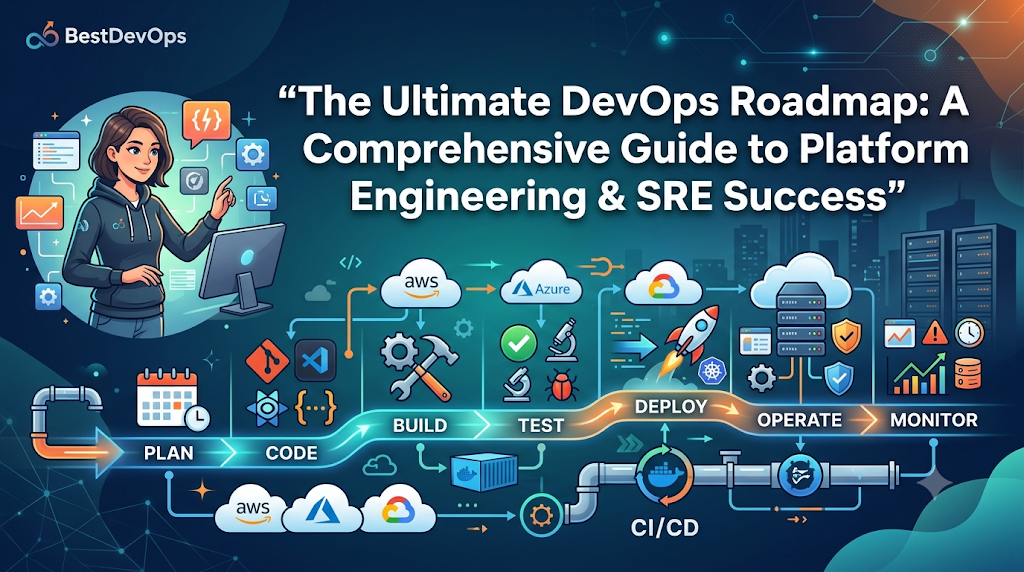
[Systems & Networking] ➔ [CI/CD & GitOps] ➔ [Infrastructure as Code] ➔ [Cloud & Containers] ➔ [SRE & Observability] ➔ [Platform Engineering]
This path is not merely about learning specific vendor utilities. Instead, it focuses on understanding systemic engineering practices—such as immutability, declarative configuration, and continuous feedback loops—that underpin modern software delivery performance.
Why a Structured Learning Path Matters
The technology landscape is saturated with utilities, frameworks, and platforms. Without a clear engineering framework, engineers risk falling into the trap of tool-driven development, where utilities are adopted because of industry trends rather than architectural necessity.
A structured learning path ensures that core concepts—such as operating system internals, networking fundamentals, and distributed systems architecture—are mastered before attempting to orchestrate large systems. This baseline knowledge is critical when troubleshooting complex production failures under strict Service Level Objectives (SLOs).
Common Enterprise Challenges in Software Delivery
Organizations frequently encounter systemic bottlenecks that slow down deployment speed and introduce instability into production environments:
- Siloed Engineering Teams: Development, security, and operations teams operating in isolation, leading to friction during handoffs.
- Configuration Drift: Inconsistencies between development, staging, and production environments caused by manual, undocumented modifications.
- Lack of Visibility: Inadequate telemetry and alerting systems that prevent teams from identifying production incidents before they impact end-users.
- Fragile Deployment Pipelines: Legacy deployment scripts lacking robust error handling, automated testing, or rollback mechanisms.
- Misaligned Performance Metrics: Measuring productivity by line count or feature velocity rather than focusing on software delivery performance and operational stability.
Key Architectural Pillars of the Roadmap
1. Operating Systems, Networking, and Core Fundamentals
Before managing cloud infrastructure, you must understand how applications interact with underlying hardware. Focus on Linux systems administration, covering process management, namespaces, cgroups, file systems, and permissions. Networking proficiency is equally critical; you must master the OSI model, TCP/IP networking, DNS resolution, HTTP/S protocols, load balancing strategies, and standard routing patterns.
2. Version Control and Git-Driven Workflows
Version control is the foundation of all automation. Teams should standardize on Git, utilizing structured branching strategies such as Trunk-Based Development or GitFlow. This pillar emphasizes that everything—including application code, infrastructure definitions, documentation, and configuration settings—must reside in a centralized, versioned repository.
3. Continuous Integration and Continuous Delivery (CI/CD)
CI/CD systems form the automated backbone of software delivery. The roadmap requires moving away from manual builds toward automated compilation, comprehensive linting, vulnerability scanning, and testing frameworks. You will need to master orchestration systems like Jenkins, GitHub Actions, and GitLab CI to construct repeatable validation pipelines.
[Code Commit] ➔ [Lint & Scan] ➔ [Unit Test] ➔ [Artifact Build] ➔ [Integration Test] ➔ [Staging Deploy]
4. Containerization and Orchestration
Containers provide predictable application runtimes across disparate infrastructure footprints. Engineers must understand how to write optimized, multi-stage Dockerfiles and manage images securely using OCI-compliant registries.
For scale, you must study Kubernetes architecture deeply, focusing on control plane mechanics, pod scheduling, custom resource definitions (CRDs), service meshes, and dynamic storage allocation using Helm charts.
5. Infrastructure as Code (IaC) and Configuration Management
Manual provisioning introduces human error and configuration drift. Modern infrastructure must be declared programmatically. The roadmap highlights declarative IaC engines like Terraform for lifecycle management of cloud resources, paired with immutable configuration management utilities such as Ansible to maintain state across instances.
6. GitOps and Declarative Continuous Deployment
GitOps evolves standard CD practices by designating Git repositories as the absolute source of truth for infrastructure and application states. By utilizing reconciliation loops provided by tools like Argo CD or Flux, the cluster state continuously synchronizes with the declared Git configuration, automatically detecting and correcting unauthorized changes.
7. Observability, Telemetry, and Site Reliability Engineering (SRE)
Observability moves beyond basic infrastructure monitoring by providing deep insight into distributed systems via metrics, logs, and traces. The roadmap emphasizes instrumenting systems using OpenTelemetry, aggregating telemetry data within analytics platforms, managing error budgets, and defining strict Service Level Indicators (SLIs) to safeguard application availability.
8. DevSecOps and Shift-Left Security
Security must be integrated directly into the engineering lifecycle rather than treated as a final review step. This involves implementing automated Secret Detection, Static Application Security Testing (SAST), Dynamic Application Security Testing (DAST), container image scanning, and enforcing fine-grained Role-Based Access Control (RBAC) configurations across all environments.
9. Engineering Intelligence and DORA Metrics
High-performing engineering organizations rely on data to optimize their software delivery pipelines. This pillar focuses on tracking core delivery metrics, evaluating deployment stability, calculating mean time to resolution (MTTR), and leveraging performance management suites like DevOpsIQ to drive continuous optimization.
The Modern DevOps Workflow
The execution of a mature software delivery pipeline relies on structured automation, integrated feedback loops, and declarative definitions.
┌───────────┐     ┌─────────────┐     ┌──────────────┐     ┌───────────────┐
│ Git Repo  │ ──> │ CI Pipeline │ ──> │ OCI Registry │ ──> │ GitOps Engine │
└───────────┘     └─────────────┘     └──────────────┘     └───────────────┘
                                                                   │
                                                                   ▼
┌───────────┐     ┌─────────────┐     ┌──────────────┐     ┌───────────────┐
│ Analytics │ <── │ Telemetry   │ <── │ K8s Cluster  │ <── │ Infrastructure│
└───────────┘     └─────────────┘     └──────────────┘     └───────────────┘
- Code Commit & Versioning: Developers commit code to a shared repository using trunk-based development practices.
- Automated Validation: The CI pipeline runs syntax validation, security scans, unit tests, and compiles the application.
- Artifact Storage: The validated application is packaged into a secure container image and pushed to a private registry.
- Declarative State Update: The deployment configuration repository is updated with the new container tag.
- GitOps Reconciliation: The CD controller detects the difference between Git and the live cluster state, pulling the new image without manual intervention.
- Infrastructure Assurance: Infrastructure adjustments are validated via IaC pipelines using plan-and-apply patterns.
- Telemetry Aggregation: OpenTelemetry agents capture performance data from the runtime environment.
- Intelligence Analysis: Platforms like DevOpsIQ analyze operational data against historical benchmarks to measure stability and performance.
Real-World Enterprise Scenarios
Scenario A: Mitigating Configuration Drift via GitOps
An enterprise financial services application suffered frequent outages caused by manual updates to staging and production Kubernetes clusters. By implementing GitOps via Argo CD, the company forced all operational adjustments to go through Git pull requests. Unauthorized manual modifications were automatically overwritten by the reconciliation loop, eliminating drift and reducing deployment incidents by over 80%.
Scenario B: Accelerated Recovery with Observability and DORA Tracking
A major e-commerce platform experienced prolonged recovery times during production incidents due to fragmented logging systems. By standardizing on OpenTelemetry for distributed tracing and deploying DORA Metrics Tools, engineers pinpointed dependencies causing failures within seconds. This optimization reduced the team’s Mean Time to Resolution (MTTR) from several hours to under fifteen minutes.
Technical and Business Benefits of DevOps Maturity
| Dimension | Technical Impact | Business Outcome |
| Delivery Speed | Shorter lead times via automated build, test, and deployment workflows. | Faster time-to-market for software features and competitive adjustments. |
| Operational Stability | Drastic reduction in deployment failures due to immutable, tested infrastructure. | Improved platform uptime and higher consumer satisfaction ratings. |
| Resource Optimization | Dynamic container orchestration matches compute usage to current traffic demands. | Reduced cloud infrastructure expenditures and optimized hardware footprints. |
| Security Alignment | Automated vulnerability scanning embedded into the active software build pipeline. | Lower risk of security breaches and adherence to regulatory compliance standards. |
Engineering Best Practices
To build stable, maintainable systems, teams should adhere to the following core engineering principles:
- Enforce Immutability: Never modify running production systems directly. Instead, update your source configurations, rebuild your container images or infrastructure components, and redeploy them completely.
- Maintain Single Sources of Truth: Ensure every piece of infrastructure, application logic, and configuration policy is defined within version-controlled repositories.
- Implement Comprehensive Automated Testing: Treat infrastructure definitions like application code. Validate IaC files with linters, security checkers, and dry-run executions before committing them.
- Design for Component Failure: Assume instances, zones, and networks will experience outages. Build resilient architectures with decoupled services, health probes, retry logic, and fallback mechanisms.
- Rely on Data-Driven Optimization: Avoid making architectural adjustments based on guesswork. Use telemetry data and delivery metrics to guide engineering decisions.
Common Anti-Patterns to Avoid
- Treating Teams as Isolated Silos: Rebranding a traditional operations team as a “DevOps Team” without changing internal processes simply creates a new bottleneck.
- Falling into Tool Obsession: Implementing complex service meshes or heavy container orchestration platforms for simple applications that could run efficiently on minimal infrastructure.
- Neglecting Feedback Loops: Creating automated deployment pipelines that push code without tracking errors, telemetry data, or system performance.
- Managing Hardcoded Secrets Poorly: Embedding API keys, database passwords, or private certificates inside application repositories or container images.
- Allowing Uncontrolled Configuration Drift: Permitting ad-hoc modifications directly on production servers without updating the source IaC templates.
Implementation Strategy: Step-by-Step Evolution
Transitioning to a highly automated software delivery model requires a phased, intentional approach to engineering processes.
Phase 1: Establish Version Control and Baseline CI
Begin by moving all codebases to a centralized repository structure. Enforce a clean trunk-based workflow and implement a basic CI pipeline that validates code quality, executes unit tests, and builds artifacts on every commit.
Phase 2: Standardize Runtimes with Containers
Migrate applications from manual server configurations to predictable, multi-stage containers. Ensure local development environments mimic production configurations closely by using identical container structures.
Phase 3: Transition to Declarative Infrastructure
Replace manual infrastructure setup with declarative IaC templates. Import existing cloud assets into your configuration files and run all infrastructure changes through peer-reviewed automation workflows.
Phase 4: Deploy Orchestration and GitOps
Introduce container orchestration for production workloads. Connect your deployment pipelines to GitOps reconciliation loops to ensure your live infrastructure state perfectly matches your version-controlled configurations.
Phase 5: Implement Observability and Continuous Feedback
Instrument your applications with distributed tracing, standardized logging, and granular metric gathering. Connect these telemetry sources to performance platforms like DevOpsIQ to track software delivery performance and systematically remove process bottlenecks.
Traditional Operations vs. Platform Engineering
The industry continues to evolve away from manually managed infrastructure toward automated, self-service platform solutions.
| Operational Model | Infrastructure Management | Deployment Verification | Telemetry Insight | Evaluation Method |
| Traditional Operations | Manual configuration changes and custom provisioning scripts. | Manual inspection and periodic scheduled testing. | Fragmented logs and basic uptime checks. | Subjective feedback and informal estimations. |
| Platform Engineering | Automated Internal Developer Platforms (IDPs). | Automated testing pipelines and clear canary policies. | Unified distributed tracing and alert budgets. | Precise DORA Metrics Tools and data analytics. |
| The DevOpsIQ Edge | Algorithmic resource planning and drift correction. | Predictive stability evaluation before releases. | Unified correlation across delivery pipelines. | Automated tracking of MTTR and deployment metrics. |
Career Guidance, Certifications, and Salaries
Navigating a career path in this space requires continuously updating technical competencies and validating expertise through industry-recognized certifications.
Core Skill Requirements
To excel, engineers must develop deep expertise in systems programming or scripting (Golang, Python, or Bash), cloud infrastructure design (AWS, Azure, or GCP), container architecture, and declarative pipeline automation.
Recommended Certifications
Validating your knowledge through structured certification programs helps advance your career. Consider pursuing these top industry certifications:
- Kubernetes Mastery: Certified Kubernetes Administrator (CKA) or Certified Kubernetes Application Developer (CKAD).
- Cloud Architecture: AWS Certified DevOps Engineer Professional or Google Cloud Professional DevOps Engineer.
- Infrastructure as Code: HashiCorp Certified: Terraform Associate.
For a broader view of the educational landscape, exploring the Best DevOps Course selections can help you build the precise competencies needed for enterprise roles.
Market Compensation Trends
Due to the high demand for specialized systems and platform automation skills, average DevOps Engineer Salary figures reflect the critical nature of these roles. Compensation scales with expertise across standard engineering tiers:
[Associate: $95k - $125k] ➔ [Senior Specialist: $140k - $185k] ➔ [Principal / Platform Lead: $195k - $250k+]
Engineering professionals can advance through these tiers by working on complex DevOps Projects and mastering the specialized DevOps Engineer Skills required to run large-scale distributed systems.
Frequently Asked Questions
Q1. What is the fundamental difference between DevOps, SRE, and Platform Engineering?
DevOps provides the cultural philosophy of unifying development and operations. Site Reliability Engineering (SRE) applies software engineering principles directly to solve complex operations problems. Platform Engineering focuses on building internal developer platforms (IDPs) that offer automated, self-service infrastructure to product teams.
Q2. Can I learn DevOps principles without a formal background in software development?
Yes. Many successful engineers transition into the field from systems administration, technical support, or quality assurance roles. The critical requirement is developing a solid understanding of programming logic, systems architecture, and automated workflows.
Q3. Why is Trunk-Based Development preferred over long-lived feature branches?
Trunk-Based Development minimizes integration friction by requiring engineers to merge small updates into a main branch frequently. This avoids the complex, error-prone merge conflicts associated with long-lived branches and ensures the codebase remains deployable.
Q4. How does Infrastructure as Code prevent configuration drift?
IaC provides a definitive, declarative template of your desired infrastructure state. When run through automated engines, these tools compare the live resources against the configuration files, automatically modifying or recreating components to match the declared source of truth.
Q5. What are the four core DORA metrics used to evaluate delivery performance?
The four core metrics are Deployment Frequency, Lead Time for Changes, Change Failure Rate, and Time to Restore Service (MTTR). These indicators accurately measure both the velocity and operational stability of an engineering organization.
Q6. When should a team choose GitOps over traditional push-based deployment pipelines?
GitOps is highly effective for cloud-native applications running on Kubernetes. It provides continuous state reconciliation, automated drift correction, and transparent auditing directly within your Git workflow. Push-based pipelines remain valuable for legacy environments or standalone virtual instances.
Q7. How do error budgets help balance feature delivery and platform stability?
An error budget defines the acceptable amount of system downtime or performance degradation within a given period (e.g., 99.9% availability allows for 43.8 minutes of downtime per month). If a team exhausts their error budget, deployment of new features is paused, and engineering focus shifts entirely to reliability improvements.
Q8. What role do service meshes play in containerized architectures?
Service meshes handle secure service-to-service communication within container clusters. They provide built-in traffic management, mTLS encryption, service discovery, and deep telemetry insight without requiring modifications to the application code.
Q9. Why should security scans be integrated directly into early pipeline stages?
Integrating security testing early in the pipeline allows vulnerabilities, exposed secrets, and compliance issues to be detected before code reaches production. This prevents costly rollbacks and reduces security risks.
Conclusion
Mastering modern software delivery requires a continuous commitment to learning technical principles, system automation, and data-driven optimization. By following a structured roadmap—from core systems administration to advanced platform engineering—engineers can build highly resilient infrastructure capable of scaling alongside enterprise demands.
True operational excellence goes beyond adopting popular tools. It relies on fostering an engineering culture focused on continuous improvement, robust observability, and objective performance analysis using platforms like DevOpsIQ. Explore our foundational learning tracks, hands-on tutorials, and comprehensive certification roadmaps to advance your engineering career.

