
Introduction
Modern engineering enterprises face a critical paradox: they have deployed more tools than ever—spanning GitHub, Jenkins, Terraform, Kubernetes, and Datadog—yet leadership still lacks clear visibility into actual engineering efficiency, risk profiles, and operational compliance. Buying more tools does not fix structural gaps in delivery execution.
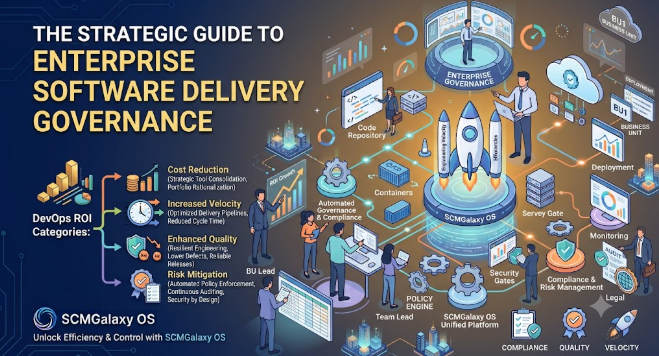
To bridge this gap, organizations are shifting toward Software Delivery Governance. This guide examines the structural blind spots in fragmented DevOps pipelines, outlines a practical approach to executing cross-domain maturity assessments, and demonstrates how purpose-built platforms like SCMGalaxy OS enable organizations to evaluate technical debt, audit compliance, and automatically generate high-impact, metrics-driven transformation roadmaps that accelerate business value.
The Paradigm Shift: From Automation to Delivery Governance
Over the last decade, organizations focused heavily on speed. The goal was to build pipelines that automated code integration and deployment. While this focus reduced manual friction, it gave rise to decentralized pipelines, disparate security configurations, unmonitored infrastructure sprawl, and zero standardized visibility into overall delivery risk.
[ Developer Code ] ➔ [ Fragmented CI/CD ] ➔ [ Multi-Cloud Deployment ]
                              │
                    ⚠️ GOVERNANCE BLINDSPOT ⚠️
                              │
                    [ SCMGalaxy OS Layer ] ➔ Continuous Assessment & Roadmaps
Automation without oversight creates risk at scale. True software delivery governance moves the conversation from “Are we deploying fast?” to “Are we deploying securely, efficiently, and predictably across every team in the enterprise?”
This is where a comprehensive Software Delivery Governance Platform like SCMGalaxy OS becomes indispensable. Rather than adding operational friction, it provides an overarching evaluation layer across distinct organizational silos. By analyzing code quality patterns, infrastructure drift, compliance gaps, and operational overhead, it empowers engineering leadership to baseline performance, eliminate risk, and guide investments based on empirical reality rather than anecdotal guesswork.
Why Tooling Alone Fails to Deliver Engineering Excellence
Most technology enterprises maintain an extensive DevOps toolchain. Yet, despite utilizing best-of-breed software, engineering leaders still run into systemic bottlenecks:
- Data Fragmentation: DORA metrics and engineering telemetry are trapped across separate systems (Jira, GitHub, SonarQube, and ArgoCD). There is no single, unified dashboard showing organizational readiness.
- Process Drift: Different product teams configure their branch protections, merge strategies, and release validation steps differently, degrading software quality standards.
- The SCM Blindspot: Basic git hosting is often mistaken for comprehensive source code governance. Without a continuous SCM Maturity Assessment, companies miss hidden risks like stale feature flags, unvetted third-party actions, and orphaned repositories.
- DevSecOps Separation: Security scanning tools flag vulnerabilities, but they rarely evaluate whether the overall team’s processes are mature enough to remediate those issues early in the software delivery lifecycle.
To scale engineering execution without adding administrative friction, organizations must look beyond individual tools and adopt a platform that evaluates how these tools are utilized, identifies systematic capability gaps, and implements continuous improvement strategies.
The Core Pillars of a Software Delivery Maturity Assessment
Evaluating an organization’s delivery engine requires looking beyond basic metrics like deployment frequency. A structured Software Delivery Maturity Assessment comprehensively analyzes the ecosystem across five distinct vectors:
| Assessment Vector | Traditional DevOps (Siloed Approach) | Governed Engineering (Maturity Model) |
| Visibility & Measurement | Team-by-team metrics compiled manually via custom scripting. | Centralized analytics tracking cross-domain KPIs automatically. |
| Risk & Compliance | Point-in-time audits that are outdated as soon as they are completed. | Continuous evaluation of release safeguards, access controls, and drift. |
| Platform Standards | Ad-hoc environments created manually, leading to snowflake configurations. | Standardized infrastructure blueprints managed via Platform Engineering teams. |
| Velocity & Flow | Speed is prioritized without tracking downstream operational debt. | Balanced focus on optimization, deployment safety, and architectural stability. |
| Feedback Loops | Alerts are trapped in monitoring silos; post-mortems lack actionable tracking. | Tight integration between SRE telemetry and upstream planning pipelines. |
Evaluating Cross-Domain Maturity: Deep Dives
To build a reliable roadmap for engineering transformation, an organization must measure its current state across the core domains that make up modern software delivery.
1. SCM and Git Governance
Source Code Management is the foundation of the delivery pipeline. An SCM Maturity Assessment goes beyond pull requests to audit branch protection policies, repository access hygiene, commit verification requirements, and dependency management. It identifies whether your foundational code storage supports stable, multi-team parallel development.
2. CI/CD and Release Architecture
A CI/CD Maturity Assessment evaluates the automation pipeline’s end-to-end efficiency. It analyzes pipeline runtimes, caching efficiency, test flake rates, and artifact traceability. A mature Release Management Maturity Assessment ensures that promotions to staging and production environments are governed by automated policy checks, canary testing arrangements, and audit-ready logs rather than manual check-sheets.
3. DevSecOps and Compliance Integration
Shifting security left requires assessing how seamlessly policy checks are woven into daily development workflows. A comprehensive DevSecOps Maturity Assessment evaluates your static and dynamic analysis coverage, software supply chain security (SBOM tracking), secrets detection mechanisms, and automated policy enforcement.
[Commit Code] ➔ [Automated Policy Guardrails] ➔ [SBOM & Secrets Scan] ➔ [Governed Artifact]
4. Site Reliability Engineering (SRE) and Observability
Deploying code is only half the battle. Organizations must understand the production ecosystem through an Observability and SRE Maturity Assessment. This phase benchmarks the maturity of Service Level Objectives (SLOs), automated alerting accuracy, runbook completeness, and self-healing infrastructure patterns.
5. Platform Engineering and Developer Experience (DevEx)
Modern platform operations focus on lowering the cognitive load for developers. This domain evaluates the availability of internal developer portals, self-service infrastructure templates (Terraform and Kubernetes governance), and the elimination of operational friction to maximize developer productivity.
6. AI Development Governance
As teams increasingly adopt large language models for code generation, new governance challenges emerge around code license validity, security vulnerabilities introduced by AI tools, and code maintainability. An AI Code Governance Platform evaluates these risks, ensuring that AI-assisted software development scales code output without accumulating technical debt.
SCMGalaxy OS: The Ultimate Governance Layer Above Your Toolchain
Rather than forcing organizations to rip and replace their existing investments in tools like GitHub, Jenkins, Jira, and Kubernetes, SCMGalaxy OS acts as an objective, overarching governance layer.
As an industry-leading Software Delivery Governance Platform, SCMGalaxy OS integrates directly with your existing infrastructure to continuously analyze and score your delivery capabilities across all engineering domains:
- Holistic Maturity Evaluation: It systematically uncovers architectural blind spots across DevOps, SCM, DevSecOps, SRE, and Platform Engineering, eliminating guesswork.
- Empirical Maturity Scoring: It replaces subjective reporting with clear, data-driven maturity scores based on industry-recognized frameworks and best practices.
- Proactive Risk Identification: SCMGalaxy OS flags delivery bottlenecks, security gaps, and operational risks before they lead to costly service interruptions or regulatory compliance failures.
- Actionable Transformation Roadmaps: Instead of presenting raw data without context, the platform instantly translates assessment results into prioritized, realistic 30-, 90-, and 180-day execution plans.
By pairing deep cross-domain visibility with prescriptive guidance, SCMGalaxy OS enables engineering leaders, CTOs, and digital transformation teams to confidently move their engineering departments toward mature, high-performing operational states.
Translating Assessment Data into Structured 30/90/180-Day Roadmaps
An assessment is only valuable if it drives meaningful change. A major benefit of leveraging the SCMGalaxy OS platform is its unique ability to turn complex assessment results into clear, sequential execution roadmaps that drive predictable engineering excellence.
  30-DAY GOALS              90-DAY GOALS             180-DAY GOALS
┌────────────────────────┐ ┌────────────────────────┐ ┌────────────────────────┐
│ • Enforce Git policies │ │ • Implement automated  │ │ • Achieve continuous   │
│ • Secure secret leaks  │ │   canary deployments   │ │   compliance auditing  │
│ • Baseline DORA metrics│ │ • Standardize IaC drift│ │ • AI-driven policy     │
└────────────────────────┘ └────────────────────────┘   enforcement            │
                                                      └────────────────────────┘
The Immediate Horizon (30-Day Plan): Secure and Baseline
Focus on remediating critical vulnerabilities, securing the software supply chain, and standardizing baseline pipeline visibility:
- Standardize branch protection rules and access controls via an updated DevOps Maturity Assessment protocol.
- Eliminate hardcoded credentials by introducing automated secrets scanning across all git repositories.
- Establish clean baseline metrics for deployment frequency and change failure rates across all product lines.
The Mid-Term Horizon (90-Day Plan): Optimize and Standardize
Focus on reducing engineering friction, optimizing automation, and introducing standardized architectural blueprints:
- Build reusable, hardened pipeline templates to eliminate variance between development teams.
- Automate environment provisioning with standardized Terraform and Kubernetes governance practices.
- Integrate security scanning (SAST/SCA) directly into CI/CD pipelines with automated quality gates that stop non-compliant builds.
The Long-Term Horizon (180-Day Plan): Scale and Automate
Focus on continuous improvement, predictive risk management, and advanced operational efficiency:
- Transition to policy-as-code models for continuous compliance monitoring.
- Implement advanced progressive delivery techniques, such as automated canary analysis and automated rollbacks tied to SRE metrics.
- Roll out an AI Code Governance Platform framework to safely manage and audit AI-assisted software development outputs.
Frequently Asked Questions (FAQs)
What is the primary difference between DevOps automation and Software Delivery Governance?
DevOps automation focuses on the execution of tasks, such as building, testing, and deploying code using tools. Software Delivery Governance provides the oversight, measurement, and optimization layer above those tools. It ensures those processes are compliant, secure, consistent, and continuously improving across the entire enterprise.
Does SCMGalaxy OS replace our current CI/CD or monitoring tools?
No. SCMGalaxy OS does not replace tools like GitHub, GitLab, Jenkins, ArgoCD, or Datadog. Instead, it integrates with them to evaluate configuration quality, identify operational risks, analyze capability gaps, and provide data-driven transformation roadmaps.
How does an SCM Maturity Assessment reduce delivery blockages?
It evaluates branching models, commit patterns, pull request cycle times, and repository access structures. Fixing these foundational issues prevents code integration delays, avoids environment configuration drift, and keeps teams aligned.
Why is AI code governance becoming necessary for engineering teams?
As developers adopt generative AI assistants, codebases often see an increase in duplicate code, potential security vulnerabilities, and licensing risks. An AI development governance framework provides the monitoring and policy compliance tools needed to use these technologies safely without accumulating technical debt.
How often should an enterprise run a Software Delivery Maturity Assessment?
Assessments should not be point-in-time events. While an initial deep assessment is critical to establishing your baseline, continuous governance evaluations—such as those built into SCMGalaxy OS—help you track progress against your 30/90/180-day roadmaps and spot regression in real time.
Conclusion & Next Steps
True engineering transformation cannot be achieved simply by adopting more tools. It requires clear visibility, structured governance, and an ongoing commitment to addressing operational maturity gaps. By shifting your focus from basic pipeline automation to comprehensive software delivery governance, you can ensure your entire development ecosystem is secure, scalable, and highly reliable.
Stop guessing your engineering maturity. Visit SCMGalaxy OS today to uncover hidden delivery risks, benchmark your engineering performance, and generate your custom 30/90/180-day engineering transformation roadmap.

