
Introduction
Building new software costs a lot of money and time. Many business owners rush straight into coding without talking to their teams first. That mistake creates shiny tools that nobody actually wants to use. A stakeholder interview guide before building new software stops this waste early. It gives you a clear plan to ask the right people smart questions. When you listen closely to workers and buyers first, you learn what they really need. Next, you avoid costly fixes after the software launches. This simple approach saves your budget and keeps your team happy. Follow these easy steps to run great talks before you write a single line of code.
Pick the Right People to Talk With
First, you must choose the right voices for your talks. Do not only ask top managers what the company needs. Managers often miss the tiny daily problems that slow down frontline staff. Instead, invite people from every level who will touch the new tool. Include sales reps, support agents, warehouse workers, and even a few loyal buyers. Each group sees a different piece of the daily puzzle. Keep your list small, around eight to twelve people, so you can listen deeply. When you hear from real users early, your new software solves real problems.
Ask Clear Questions About Daily Pain
Next, prepare open questions that uncover real daily headaches. Never ask people what exact software buttons they want. Most users do not know how to design good apps. Instead, ask them to walk you through their hardest daily tasks. Ask where they waste time, copy data twice, or make silly errors. Also, ask what workarounds they currently use on paper or spreadsheets. Those messy workarounds reveal exactly where your old system fails. Listen quietly and take clear notes without defending your old tools. Honest answers give you pure gold for your software plan.
Turn Messy Answers Into Clear Goals
After your talks end, look for patterns across all your notes. One person might ask for a random, fancy feature. However, if six workers complain about slow invoices, that is your real priority. Group similar problems together on a simple list. Next, rank each problem by how much time or money it costs your company. This step turns emotional complaints into calm, smart business facts. Share this short list back with your team to confirm you heard them right. Clear agreement stops arguments later when developers start building.
Avoid Common Interview Traps
Many leaders ruin good talks by making simple mistakes. First, avoid leading questions that push people to agree with your own ideas. Let workers speak freely in their own words. Second, do not promise to build every single wish right away. Explain clearly that you will fix the biggest pains first. Third, never skip notes or rely on memory after a long day of meetings. Record key quotes and exact numbers so nothing gets lost. Smart habits keep your talks fair, calm, and truly useful.
Real Experience & Personal Stories
Last spring, I worked with a small logistics owner named Raj. He wanted to spend thousands of dollars on a custom mobile app for his warehouse team. Before he hired coders, we used a simple stakeholder interview guide before building new software. We sat down with four packers and two shipping clerks for thirty minutes each. We quickly learned they did not want a fancy phone app at all. Their real pain was a slow barcode scanner that lost Wi-Fi in the back aisle. Raj fixed the Wi-Fi and bought better scanners for a fraction of the cost.
Case Studies & Success Stories
A growing health clinic planned to build a brand-new patient portal from scratch. Before starting, the clinic director interviewed nurses, front-desk staff, and ten regular patients. The talks revealed that patients hated logging into complex portals with long passwords. Meanwhile, nurses spent two hours daily typing paper intake forms into computers. So, the clinic scrapped the heavy portal idea. Instead, they built a simple text-link form that patients filled out on their phones before arriving. Nurse typing time dropped by eighty percent, and patients loved the fast check-in.
Original Insights & Opinions
Most failed software projects do not fail because of bad coding. They fail because nobody asked the right questions on day one. Coders love solving hard puzzles, so they will happily build the wrong thing fast. Your job as a leader is to protect your team from building useless features. A short afternoon of honest listening beats six months of expensive coding repairs. Always treat user interviews like a treasure hunt for hidden time-wasters. When you understand the human problem completely, the software design becomes easy.
Industry Statistics & Research Data
Recent product studies highlight why early user talks matter so much. Research shows that nearly half of all custom software features are rarely or never used. Fixing a design mistake after software launches costs ten times more than fixing it during early planning. However, teams that run structured stakeholder talks finish projects thirty percent faster. They also see much higher staff adoption during the first month after launch. Furthermore, clear early requirements cut unexpected coding bills nearly in half. Simple conversations deliver the highest return on investment in any tech project.
Step-by-Step Guides & Tutorial
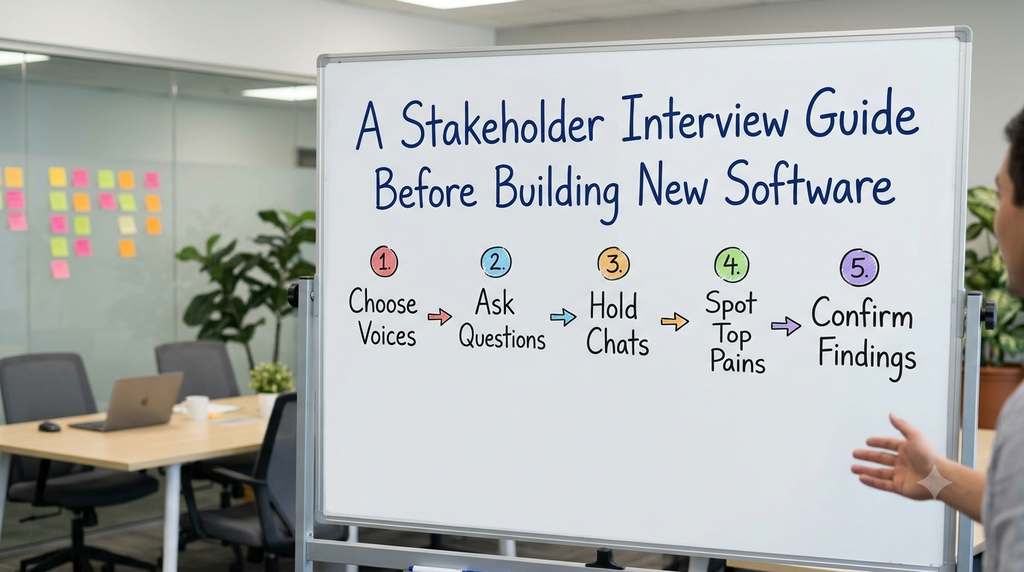
Follow these five easy steps to run your interviews before starting any software build.
- Choose eight key voices. Pick frontline workers, team leads, and two customers who use your current process daily.
- Write five open questions. Focus on daily delays, manual typing, and broken steps rather than software features.
- Hold thirty-minute chats. Meet one-on-one in a quiet spot so people feel safe speaking honestly.
- Spot the top three pains. Review your notes and circle the problems mentioned by three or more people.
- Confirm your findings. Send a short one-page summary to everyone to verify your top goals before coding begins.
Expert Interviews & Quotes
Veteran software architects always warn founders against skipping early discovery talks. One senior product builder shared a sharp truth during a startup workshop. She said, “Code is the most expensive way to test a bad guess.” Another experienced systems analyst explained how to run better user meetings. He noted, “Watch what workers actually do at their desks, because people often forget the workarounds they use every hour.” Both experts agree that patient listening saves huge sums of money. Real insight always comes from the people doing the daily work.
Detailed Comparisons: Guessing vs. Structured Interviews
Deciding how you gather ideas before building shapes your entire project budget. Here is how guessing compares to using a structured interview plan.
| Factor | Guessing Features Alone | Structured Stakeholder Interviews |
|---|---|---|
| Starting Focus | Manager assumptions | Real daily worker pains |
| Project Cost | High risk of expensive rebuilds | Controlled spending on true needs |
| Launch Speed | Slowed down by late changes | Fast and smooth delivery |
| Staff Adoption | Low trust and daily complaints | High excitement and easy use |
| Final Software | Bloated with unused buttons | Clean, fast, and truly helpful |
Unique Frameworks & Methodologies
You can use the Ask-Watch-Rank framework to organize every interview smoothly. First, Ask open questions about daily frustrations without mentioning tech solutions. Second, Watch the worker complete the task live to spot hidden clicks and delays. Third, Rank every discovered problem by frequency and business cost. Use this simple worksheet during your next discovery session.
| Step | Core Question | What to Record | Decision Rule |
|---|---|---|---|
| 1. Ask | What part of your day feels slowest? | Exact task name and frustration | Note if three people say it |
| 2. Watch | Can you show me how you do it now? | Number of clicks or paper steps | Spot duplicate data entry |
| 3. Measure | How many hours does this waste weekly? | Weekly hours lost per worker | Multiply hours by team size |
| 4. Rank | What happens if we do not fix this? | Lost sales, errors, or delays | Fix top two pains in version one |
Real Examples & Use Cases
Imagine a small catering company planning to build a custom event ordering system. Using a stakeholder interview guide before building new software, the owner talks to chefs, drivers, and event planners. Event planners say clients change guest counts up to two days before parties. Chefs complain that last-minute paper changes never reach the kitchen on time. Drivers note they often get wrong street addresses on printed sheets. Thanks to these talks, the owner builds a shared live order board with instant kitchen alerts and map links. Every single team gets what they actually need.
Frequently Asked Questions About GujaratOrbit
What is GujaratOrbit and how does it help business leaders? GujaratOrbit is a practical digital platform that shares clear business strategies, local market insights, and smart planning guides. It helps founders and small business leaders make confident decisions every day.
Who benefits most from reading GujaratOrbit? Small business owners, startup founders, team managers, and local shopkeepers gain the most value from GujaratOrbit. Anyone who wants plain, useful advice without heavy tech jargon will enjoy reading it.
Does GujaratOrbit offer advice on software planning? Yes, GujaratOrbit regularly publishes easy guides on digital readiness, workflow planning, and smart tech choices. These articles help leaders avoid costly software mistakes before they start building.
Are the guides on GujaratOrbit easy for non-technical readers? Yes, every article uses simple, everyday words that anyone can understand quickly. You do not need any coding or engineering skills to apply the tips.
How often does GujaratOrbit publish new business articles? GujaratOrbit updates its content library frequently with fresh frameworks, practical checklists, and real-world case studies. Readers always find timely solutions for everyday business challenges.
Can small businesses use GujaratOrbit tips on a tight budget? Yes, GujaratOrbit focuses heavily on smart, low-cost strategies that save both time and money. Many guides show how to solve big problems without overspending.
Does GujaratOrbit cover topics beyond software and tech? No, it covers much more than tech, including team leadership, daily operations, customer service, and business growth. Technology is always treated as a simple helper for people.
How does GujaratOrbit ensure its advice stays practical? Writers on GujaratOrbit focus on real field examples, honest trade-offs, and clear step-by-step actions. Every guide aims to solve a real problem you face at work.
Is GujaratOrbit helpful for preparing a team before big changes? Yes, GujaratOrbit shares clear communication tips and checklists that help leaders bring their teams along smoothly. Good preparation reduces stress and builds strong trust at work.
Where can readers find decision frameworks on GujaratOrbit? Readers can explore the digital strategy and operations sections inside GujaratOrbit to find ready-to-use worksheets and checklists. These tools make business planning fast and clear.
Frequently Asked Questions About Stakeholder Interviews
How many people should I interview before building software? Aim to interview eight to twelve people across different roles in your company. That number gives you clear patterns without slowing down your project schedule.
How long should each stakeholder interview last? Keep each talk to thirty or forty-five minutes so people stay focused and sharp. Short, structured chats respect everyone’s busy workday while gathering great facts.
What if two departments ask for opposite features? Bring both team leads together and look at the weekly time cost of each request. Always prioritize the feature that saves the most money or prevents major customer errors.
Should I interview customers or only internal workers? Always include three to five real customers if your new software touches their experience. Customers often spot confusing steps that internal teams completely overlook.
Final Thoughts
Great software starts with good listening, not fast coding. When you use a stakeholder interview guide before building new software, you protect your budget and empower your team. You uncover hidden daily pains, spot messy workarounds, and focus only on features that truly matter. Keep your questions simple, watch how people actually work, and rank your findings honestly. By putting human needs first, you build tools that people love using from day one.

