
Introduction
The modern enterprise landscape is undergoing a massive shift in how data pipelines are constructed, scaled, and maintained. For years, organizations treated data engineering as a isolated discipline, separate from the rigorous automated practices of traditional software development. This siloed approach consistently leads to broken pipelines, uncalibrated data quality, and delayed business insights. To bridge this gap, DataOps has emerged as a crucial methodology that applies DevOps, Agile, and Lean manufacturing principles to data workflows. This comprehensive guide is written specifically for software engineers, site reliability engineers, platform architects, and engineering managers who want to understand the Certified DataOps Manager (CDOM) framework. Navigating this career path helps professionals make highly informed decisions, ensuring they can lead technical teams and build production-grade, automated data infrastructure that meets modern enterprise standards. You can explore the complete curriculum and program structure directly through the DataOpsSchool official platform to align your training goals.
What is the CDOM – Certified DataOps Manager?
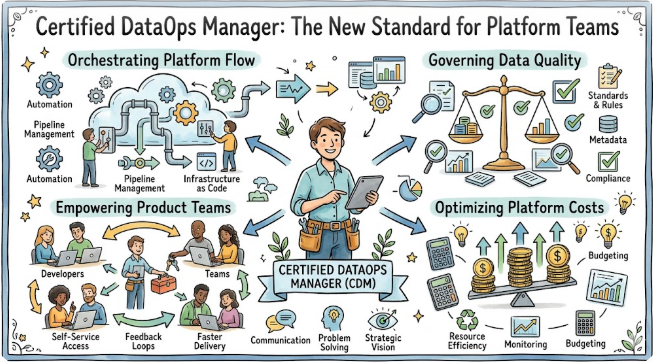
The Certified DataOps Manager (CDOM) designation represents the industry standard for professionals capable of orchestrating complex data environments using automated, repeatable methodologies. It exists because traditional data management frameworks fail to handle the sheer volume, velocity, and variety of modern cloud data architectures. Rather than focusing purely on theoretical data models or isolated database administrative tasks, this program emphasizes real-world, production-focused learning. It aligns directly with modern engineering workflows by incorporating continuous integration, continuous delivery, and comprehensive automated testing into the data lifecycle. Enterprise practices require systems that eliminate manual data provisioning and reduce pipeline downtime, making the CDOM framework an essential blueprint for building resilient data platforms.
Who Should Pursue CDOM – Certified DataOps Manager?
This professional path specifically benefits software engineers, site reliability engineers, cloud architects, security professionals, and data engineers who want to transition from basic pipeline scripting to architectural governance. Beginners with a foundational background in systems engineering will find a clear roadmap for advancement, while experienced engineers and technical managers can leverage the framework to validate their strategic implementation capabilities. On a global scale, enterprises are rapidly restructuring their data departments to mirror platform engineering teams, making this knowledge universally relevant. In major tech hubs across India and international markets, the demand for leaders who can unify data operations with cloud-native infrastructure is scaling exponentially, making this certification highly valuable for cross-functional professionals.
Why CDOM – Certified DataOps Manager is Valuable and Beyond
The longevity of this framework lies in its decoupling from specific, short-lived software tooling, focusing instead on immutable operational principles. While individual databases, orchestrators, and cloud providers fluctuate in popularity, the underlying need for automated data testing, version control, and environment provisioning remains permanent. Pursuing this path guarantees a substantial return on time and career investment, as it elevates a professional from a tactical tool administrator to a strategic architectural leader. Enterprises actively adopt these practices to minimize operational overhead, decrease time-to-market for analytical models, and prevent catastrophic data compliance failures. By establishing mastery over these areas, you insulate your career against automation shifts and position yourself for high-impact leadership roles.
CDOM – Certified DataOps Manager Certification Overview
The complete educational program and its associated assessments are delivered entirely via the CDOM – Certified DataOps Manager and hosted on the DataOpsSchool. The certification structure is designed around practical, objective-based evaluations rather than simple multiple-choice memorization tests. Ownership of this program rests with industry practitioners who continuously update the curriculum to reflect actual enterprise incidents and modern cloud-native architectural patterns. The structural blueprint spans across distinct technical competencies, forcing candidates to prove their capabilities in versioning data infrastructure, managing automated testing suites, and governing data quality at scale.
CDOM – Certified DataOps Manager Certification Tracks & Levels
The curriculum is divided into foundational, professional, and advanced tiers to mirror actual career progression within an enterprise. The foundational tier focuses on core automation syntax, version control concepts, and basic pipeline monitoring mechanisms. As candidates advance to the professional level, the focus shifts toward multi-environment orchestration, distributed data architectures, and automated testing strategies. The advanced tier addresses enterprise governance, cost optimization, cross-functional team management, and global data compliance compliance frameworks. Specialized tracks permit professionals to align their study with specific engineering domains, ensuring that an SRE or Data Engineer can specialize in aspects most relevant to their immediate operational mandates.
Complete CDOM – Certified DataOps Manager Certification Table
| Track | Level | Who it’s for | Prerequisites | Skills Covered | Recommended Order |
| Core Operations | Foundation | Junior Engineers, Systems Analysts | Basic Linux & Python knowledge | Version control, Data orchestration basics, CI/CD pillars | 1st |
| Architecture | Professional | Data Engineers, Infrastructure Leads | 2+ years cloud infrastructure experience | Automated testing, Multi-environment deployments, Pipeline monitoring | 2nd |
| Enterprise Governance | Advanced | Engineering Managers, Director level | 5+ years technical leadership experience | SLA management, Compliance automation, Cost optimization, Team scaling | 3rd |
Detailed Guide for Each CDOM – Certified DataOps Manager Certification
CDOM – Certified DataOps Manager – Foundation Level
What it is
This level validates a candidate’s fundamental understanding of applying continuous integration and automated deployment philosophies to data workflows, ensuring they can contribute to basic pipeline operations without introducing manual errors.
Who should take it
Junior software engineers, entry-level data analysts, and systems administrators who want to build a verifiable foundation in modern data infrastructure automation.
Skills you’ll gain
- Version control implementations for complex data schemas.
- Core principles of basic pipeline orchestration engines.
- Understanding automated data quality checks within a delivery pipeline.
Real-world projects you should be able to do
- Construct a fully automated code repository that triggers a basic data extraction and loading sequence upon every code commit.
- Implement a basic data validation script that automatically isolates corrupted records before they reach a production warehouse.
Preparation plan
- 7–14 days: Review foundational documentation regarding containerization basics and version control workflows. Practice creating simple automated scripts.
- 30 days: Spend an hour daily building localized data pipelines using open-source orchestration tools to understand state management.
- 60 days: Execute comprehensive mock exams, build multiple end-to-end local pipelines, and review primary architectural whitepapers.
Common mistakes
- Focusing entirely on theoretical data models while ignoring practical command-line automation and version control syntax.
- Skipping the foundational study of containerization frameworks, which are vital for modern deployment.
Best next certification after this
- Same-track option: Professional Level DataOps Architect.
- Cross-track option: Cloud Infrastructure Associate.
- Leadership option: Technical Team Lead Foundation.
CDOM – Certified DataOps Manager – Professional Level
What it is
This tier verifies an engineer’s capability to design, deploy, and maintain multi-tier automated data environments that handle complex transformations, strict service-level agreements, and automated recovery actions.
Who should take it
Mid-to-senior data engineers, site reliability engineers, and platform professionals responsible for the stability and scalability of enterprise data systems.
Skills you’ll gain
- Advanced multi-environment orchestration and state management across cloud environments.
- Designing automated testing frameworks for large-scale, distributed analytical processing.
- Implementing deep observability, alerting metrics, and telemetry across live pipelines.
Real-world projects you should be able to do
- Design a multi-stage production deployment pipeline that utilizes blue-green deployment methodologies to update live database schemas without interrupting active user queries.
- Build a comprehensive, real-time alerting framework that catches processing delays within five minutes and automatically provisions additional compute resources.
Preparation plan
- 7–14 days: Focus heavily on distributed systems theory, advanced container orchestration patterns, and deep environment isolation techniques.
- 30 days: Build complex, multi-stage pipeline projects using live cloud resources, incorporating realistic failure modes to practice automated recovery.
- 60 days: Conduct extensive architectural reviews of existing open-source frameworks, optimizing configuration parameters for performance and cost efficiency.
Common mistakes
- Underestimating the complexity of live state management when deploying infrastructure updates to databases.
- Designing fragile testing suites that trigger excessive false-positive alerts, blinding operations teams to real production defects.
Best next certification after this
- Same-track option: Advanced Enterprise DataOps Director.
- Cross-track option: Site Reliability Engineering Professional.
- Leadership option: Certified Engineering Manager.
CDOM – Certified DataOps Manager – Advanced Level
What it is
This certification certifies an individual’s capability to architect global data platforms, manage cross-functional engineering organizations, enforce international data regulations through automated policies, and control enterprise cloud budgets.
Who should take it
Principal engineers, enterprise architects, engineering managers, and technical leaders who direct the overall organizational data strategy and operational standards.
Skills you’ll gain
- Institutionalizing automated compliance, data lineage tracking, and governance-as-code policies.
- Financial engineering and cloud cost optimization across distributed storage and computing layers.
- Strategic organizational design for scaling high-performing technical platform teams.
Real-world projects you should be able to do
- Architect an enterprise-wide governance framework that programmatically masks sensitive customer information across all staging and development environments automatically.
- Formulate and execute a comprehensive cloud cost reduction strategy that cuts data processing overhead by thirty percent without decreasing query performance or breaching established SLAs.
Preparation plan
- 7–14 days: Study international data compliance directives, advanced financial cloud management methodologies, and high-level organizational communication principles.
- 30 days: Analyze detailed enterprise case studies focusing on massive system failures, tracing technical root causes and designing long-term preventative policies.
- 60 days: Author comprehensive technical strategies outlining platform migrations, risk assessment metrics, and complete financial impact models for senior leadership review.
Common mistakes
- Concentrating too heavily on low-level syntax corrections instead of master-level architecture, fiscal governance, and multi-team collaboration dynamics.
- Failing to design operational policies that scale across diverse product development teams, resulting in organizational bottlenecks.
Best next certification after this
- Same-track option: Executive Technology Leadership Core.
- Cross-track option: Advanced Enterprise Platform Architect.
- Leadership option: Chief Technology Officer Strategy Program.
Choose Your Learning Path
DevOps Path
Professionals coming from a pure software operations background must shift their focus from static web application deployments to dynamic, stateful data environments. This path guides you through adapting traditional continuous integration systems to manage large-scale database schema migrations safely. You will learn to treat infrastructure configurations as version-controlled code, ensuring that data processing clusters can be destroyed and recreated deterministically. Mastering this progression allows traditional operations engineers to seamlessly absorb data infrastructure duties into their standard deployment frameworks.
DevSecOps Path
Security cannot exist as an afterthought or a final manual check before a production deployment occurs. This path teaches security-focused engineers how to integrate automated security compliance scanning directly into active data pipelines. You will master the implementation of programmatic data anonymization, automated role-based access controls, and persistent encryption key rotation patterns. By completing this track, professionals ensure that enterprise data environments remain completely secure against internal leaks and external threats without slowing down the development velocity of analytics teams.
SRE Path
Site reliability engineers focusing on data infrastructure must prioritize system availability, pipeline throughput, and automated error mitigation patterns. This curriculum concentrates heavily on defining accurate service level indicators and objectives specifically tailored for data freshness and quality parameters. You will gain deep expertise in building self-healing pipeline components that automatically quarantine malformed payloads while preserving total system runtime. This path guarantees that data platforms remain resilient under unpredictable volumes and infrastructure failures.
AIOps Path
Engineers within this specialized domain learn to apply advanced automated operational principles to the telemetry data generated by enterprise infrastructure. This path bridges the gap between infrastructure monitoring systems and intelligent, automated root-cause analysis engines. You will master the collection, normalization, and structured storage of massive log and metric streams to enable algorithmic detection of anomalies. This training turns basic infrastructure monitoring into a predictive system capable of preventing downtime before it affects users.
MLOps Path
Machine learning workflows present unique operational challenges because they require versioning code, training data, and complex model weights simultaneously. This roadmap instructs engineers on how to build reliable production environments that automate the continuous training, evaluation, and deployment of analytical models. You will design automated evaluation steps that compare live model performance metrics against historical baselines before allowing an update to proceed. This ensures that artificial intelligence applications remain accurate, stable, and highly performant over time.
DataOps Path
This central track focuses squarely on the holistic orchestration of data processing environments, addressing the historical friction between data developers and infrastructure operators. You will gain comprehensive knowledge regarding continuous data quality monitoring, automated environments provisioning, and cross-functional pipeline governance. This path transforms traditional data groups into modern engineering units that deliver reliable analytics with velocity and consistency.
FinOps Path
Modern cloud data infrastructure can easily incur massive financial waste if compute and storage resources are left unmonitored or poorly architected. This path empowers professionals to merge financial accountability with cloud-native engineering by setting up automated cost allocation tags and budget alerts. You will master the art of identifying underutilized data warehouses, rightsizing distributed computing clusters, and implementing auto-scaling policies based on resource consumption. This structural learning ensures that the scalability of your data environment aligns with corporate financial sustainability.
Role → Recommended CDOM – Certified DataOps Manager Certifications
| Role | Recommended Certifications |
| DevOps Engineer | CDOM Foundation + Professional Track |
| SRE | CDOM Professional + SRE Specialized Track |
| Platform Engineer | CDOM Professional + Advanced Enterprise Track |
| Cloud Engineer | CDOM Foundation + Core Cloud Operations Track |
| Security Engineer | CDOM Professional + DevSecOps Security Track |
| Data Engineer | CDOM Foundation + Professional Data Track |
| FinOps Practitioner | CDOM Professional + FinOps Cost Management Track |
| Engineering Manager | CDOM Advanced Enterprise Governance Track |
Next Certifications to Take After CDOM – Certified DataOps Manager
Same Track Progression
Upon mastering the core operational frameworks, advanced specialists should look toward deep infrastructure specializations that focus exclusively on high-throughput distributed network engines and petabyte-scale real-time processing architectures. This progression cements your status as a primary technical authority capable of resolving complex technical failures that span multiple global cloud availability zones.
Cross-Track Expansion
To build a highly diversified and robust technical profile, professionals should expand their expertise into adjacent fields like comprehensive platform engineering, global cloud architecture networks, and modern cyber-security operations. Branching into these related disciplines ensures you can design whole systems that protect and support corporate assets across any computing medium.
Leadership & Management Track
For senior practitioners aiming to transition away from daily script writing into strategic corporate governance, pursuing structured programs in enterprise technology management, corporate finance engineering, and executive leadership is the natural progression. This training refines your ability to negotiate vendor agreements, direct large capital allocations, and design multi-departmental organizational frameworks.
Training & Certification Support Providers for CDOM – Certified DataOps Manager
DevOpsSchool offers deeply technical, hands-on instructional bootcamps directed by industry practitioners, focusing on the practical application of continuous integration tools and configuration management practices within live production environments.
Cotocus provides customized enterprise training solutions aimed at shifting traditional engineering structures toward automated infrastructure provisioning, container orchestration, and multi-tier cloud delivery models.
Scmgalaxy serves as a comprehensive knowledge base and active community center, providing engineers with exhaustive tutorials, documentation reviews, and configuration scripts focused on version control and release automation.
BestDevOps focuses its educational programs on the optimization of system architectures, providing practical training modules designed to reduce pipeline downtime and implement efficient logging frameworks across enterprise infrastructures.
devsecopsschool specializes in the structural integration of automated security compliance scanners, vulnerability testing, and secure identity management directly within existing development workflows.
sreschool provides targeted education regarding system reliability engineering, equipping candidates with the skills to construct highly reliable, self-healing platforms that maintain continuous availability under heavy user traffic.
aiopsschool centers its specialized curriculum on utilizing machine learning algorithms to evaluate enterprise telemetry streams, helping organizations build predictive monitoring solutions.
dataopsschool stands as the definitive education provider for this specific curriculum, offering deep analytical modules, project templates, and realistic sandbox environments tailored for automated data management.
finopsschool delivers highly structured training focused entirely on cloud financial management, teaching technology professionals how to optimize compute allocations and manage corporate infrastructure budgets efficiently.
Frequently Asked Questions (General)
- What is the primary career benefit of pursuing an infrastructure automation pathway?
It elevates your professional capability from basic, manual system management to building automated platforms that handle enterprise workloads cleanly without constant manual oversight. - How long does it typically take to prepare for a professional level assessment?
For an engineer with prior cloud experience, thirty to sixty days of structured study and hands-on laboratory work is generally sufficient. - Are there strict technical prerequisites before attempting foundational certifications?
A basic familiarity with the Linux command line interface, version control workflows, and a foundational scripting language like Python is highly recommended. - How does this learning pathway improve an organization’s operational speed?
By eliminating manual deployments, standardization errors are mitigated, allowing features to transition from development to live production in a fraction of the time. - Do these programs focus exclusively on a single cloud vendor platform?
No, the educational core addresses cloud-agnostic concepts and architectural philosophies that apply equally across all primary hyperscalers. - What is the return on investment regarding technical certifications for engineering leaders?
It establishes a validated baseline of technical proficiency across engineering groups, reducing onboarding friction and lowering project failure rates. - How do these frameworks address system downtime issues?
By implementing comprehensive automated testing and continuous monitoring infrastructure, defects are detected and mitigated before affecting end users. - Can non-engineering professionals benefit from pursuing foundational tracks?
Yes, product owners and business analysts can gain invaluable insights into operational limits, helping them form realistic project timelines. - What distinguishes a professional tier engineer from an advanced tier professional?
Professional tier engineers focus on the implementation and stabilization of systems, while advanced professionals handle budget strategies, cross-team alignment, and corporate compliance frameworks. - How often are these certification syllabi updated to match industry trends?
Curriulums are reviewed and updated regularly to account for structural changes in production-grade systems and open-source updates. - Is hands-on lab work mandatory to pass these examinations?
Yes, objective-based testing methodologies evaluate practical troubleshooting capabilities, making actual lab experience crucial for success. - How do these certifications help professionals maintain career relevance?
By prioritizing structural design principles over specific tool syntax, your technical skill set remains applicable regardless of software popularity shifts.
FAQs on CDOM – Certified DataOps Manager
- What specific operational issues does the CDOM designation address within an enterprise data environment?
The CDOM program targets broken analytical pipelines, variable data quality, lack of environment isolation, and excessive manual deployment intervention. By formalizing these concepts, managers can implement strict testing suites that guarantee data integrity throughout the transformation lifecycle. - How does a CDOM qualification alter an engineer’s career path compared to a standard database administrator?
Traditional database administrators focus heavily on localized server maintenance, performance tuning, and access provisioning. A certified professional operates at an architectural layer, configuring whole automated frameworks that allow product teams to securely provision their own isolated data testing environments automatically. - Is the CDOM assessment purely theoretical or does it require live environment configuration?
The examination format evaluates a candidate’s practical architectural knowledge and execution capabilities. You must demonstrate that you can structure real-world automation workflows, configure state management protocols, and implement multi-tier deployment scenarios that prevent schema corruption or application downtime during updates. - Can an engineer with only DevOps experience successfully transition into a CDOM role?
Yes, software operations professionals already understand the fundamentals of continuous integration, containerization, and monitoring. This background provides an excellent foundation, allowing them to easily learn specific data challenges like handling state preservation and schema migration constraints. - What role does data governance play within the advanced certified manager curriculum?Governance is treated as an automated process rather than a set of static policy documents. The advanced track instructs leaders on how to enforce regulatory compliance, data masking rules, and access permissions programmatically across all automated deployment paths.
- How does achieving this certification impact an engineer’s profile in the competitive Indian technology market?
As large enterprises across India transition away from brittle legacy reporting structures to dynamic data-driven software products, the demand for orchestration expertise is skyrocketing. This qualification directly differentiates you as a rare professional who unifies platform engineering mechanics with data pipeline needs. - What is the recommended sequence for completing the CDOM certification tracks successfully?Candidates should always begin with the foundation track to align their understanding of automated terms and basic repository structures. From there, advance to the professional level to tackle multi-environment orchestration, and finally target the advanced track for enterprise management.
- How does a CDOM professional manage cloud computing costs effectively during massive processing jobs?
The program highlights automated infrastructure optimization strategies, instruction on cluster rightsizing, and implementation of variable compute scheduling. This knowledge prevents teams from maintaining active, expensive computing resources during idle pipeline intervals, lowering overall cloud operational bills.
Final Thoughts: Is CDOM – Certified DataOps Manager Worth It?
When determining whether to invest your limited professional development time into the Certified DataOps Manager framework, look closely at the operational realities of your current and future engineering organizations. Brittle data systems built on manual workflows, ad-hoc patching, and unmonitored processing tracks are no longer viable in high-velocity engineering environments. Organizations require professionals who treat data delivery with the same structural engineering rigor traditionally reserved for mission-critical microservices. This program does not sell tool-specific shortcuts or fleeting trends; it builds a permanent understanding of automation engineering, pipeline observability, and environmental governance. If your career objective is to remain a tactical administrator executing manual commands, this path is not for you. However, if you want to establish yourself as a vital platform leader capable of designing resilient architectures that handle complex enterprise data flows, this framework provides a highly direct and effective route to that objective.

