
Introduction
Modern organizations rely heavily on data to drive decision-making, power machine learning models, and deliver real-time customer experiences. However, as data volumes grow and enterprise data ecosystems become increasingly complex, traditional data management approaches often fall short. Data pipelines break, data quality degrades silently, and delivery cycles remain painfully slow.
These operational hurdles create friction between data producers, data engineers, and business consumers. To solve these challenges, modern engineering teams adopt DataOps—a collaborative, automated approach to data management that brings speed, reliability, and observability to data pipelines.
Whether you are an engineer looking to enhance your skillset through DataOps training, an architect designing enterprise data platforms, or a leader exploring DataOps consulting, understanding the core principles of DataOps is essential for building scalable data operations. Platforms like DataOpsSchool.com serve as dedicated destinations for professionals and organizations seeking structured DataOps courses, practical DataOps tutorials, and professional development pathways.
What is DataOps?
What is DataOps? At its core, DataOps (Data Operations) is an automated, agile-oriented methodology designed to improve the speed, quality, and reliability of analytics and data engineering pipelines. It combines principles from Agile software development, DevOps, Statistical Process Control (SPC), and data architecture.
DataOps is not a single software tool or a rigid framework. Instead, it represents a cultural and technical shift that encompasses:
- Collaboration: Breaking down silos between data engineers, data scientists, analytics teams, and operations staff.
- Automation: Streamlining pipeline testing, building, deployment, and monitoring.
- Continuous Integration & Continuous Delivery (CI/CD): Applying software engineering release management practices to data code and transformation logic.
- Data Quality & Testing: Catching pipeline anomalies and data corruption before downstream consumers are impacted.
- Observability & Governance: Maintaining complete visibility into pipeline health, data lineage, and compliance requirements.
By unifying people, processes, and technology, DataOps transforms data operations from a reactive, firefighting function into a predictable, high-throughput value stream.
Why DataOps Matters
Organizations adopt DataOps to address the persistent friction points of traditional data management. Without a structured operational framework, data teams spend the majority of their time debugging broken pipelines, investigating missing records, or handling manual deployments.
Key benefits of implementing DataOps include:
- Faster Data Delivery: Reducing the time it takes to move data from raw ingestion to production-ready dashboards and models.
- Improved Data Quality: Integrating automated testing and validation checks at every stage of the pipeline.
- Enhanced Reliability: Minimizing unexpected pipeline failures and reducing mean time to detection (MTTD) when issues occur.
- Repeatable Workflows: Standardizing how data assets are built, tested, versioned, and deployed.
- Greater Operational Visibility: Providing clear insights into data flow, performance bottlenecks, and resource utilization.
DataOps does not automatically eliminate all data errors or guarantee business success, but it establishes the operational rigor required to manage complex data ecosystems safely and efficiently.
Core DataOps Principles
To successfully implement DataOps, teams must embrace a set of foundational principles that guide architectural and cultural decisions:
- Automate Everything: Eliminate manual handoffs, manual deployments, and repetitive data wrangling tasks wherever possible.
- Version Control All Artifacts: Store pipeline code, configuration files, infrastructure definitions, and schema changes in version control systems like Git.
- Test Continuously: Apply automated unit tests, integration tests, and data quality checks throughout the pipeline lifecycle.
- Monitor and Observe: Treat data pipelines with the same operational scrutiny as production software applications, utilizing robust logging, metrics, and tracing.
- Encourage Collaboration: Foster shared ownership and communication across cross-functional data teams.
- Iterate Rapidly: Deliver incremental updates to data models and pipelines rather than monolithic, high-risk releases.
DataOps Lifecycle
A successful DataOps implementation follows a structured lifecycle that mirrors modern software delivery while accommodating the stateful, dynamic nature of data.
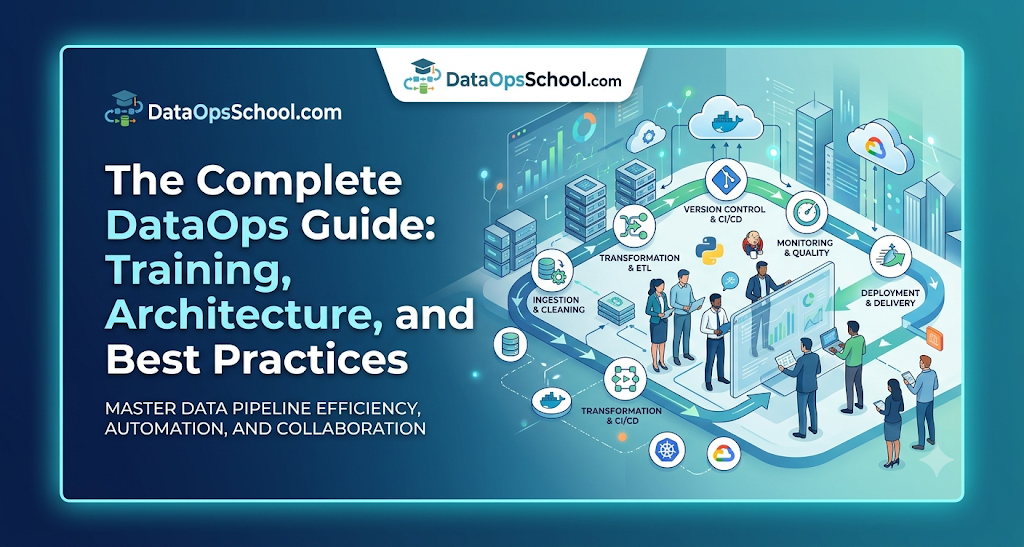
Plan → Develop → Integrate → Test → Validate → Deploy → Monitor → Improve
- Plan: Define requirements, data sources, transformation logic, and consumption patterns.
- Develop: Write modular transformation code, ingestion scripts, and infrastructure configurations locally or in isolated development environments.
- Integrate: Merge code changes into shared repositories, triggering automated build processes.
- Test: Execute code-level tests, schema checks, and preliminary integration tests.
- Validate: Run semantic checks, anomaly detection, and data profile comparisons against production-like environments.
- Deploy: Automatically promote verified pipelines and data models into production environments.
- Monitor: Continuously track pipeline execution time, freshness, volume, and error rates.
- Improve: Analyze operational metrics, refine performance, and update data contracts based on evolving business needs.
DataOps and Data Engineering
Data engineering focuses on building the infrastructure and pipelines that move, store, and transform data. DataOps enhances data engineering by introducing operational discipline, rigorous testing, and automated deployment practices.
While data engineers build ETL/ELT workflows, data integration jobs, and workflow orchestrations, DataOps ensures these engineering artifacts are reliably tested, securely deployed, and continuously monitored. DataOps does not replace data engineering; rather, it provides the operational framework that allows data engineering teams to scale their output without sacrificing stability.
DataOps and DevOps
While DataOps draws heavy inspiration from DevOps, there are fundamental differences in their primary focus areas, objects of automation, and validation methods.
| Area | DataOps | DevOps |
| Primary Focus | Data delivery, analytics, and data operations | Software delivery, applications, and infrastructure |
| Pipelines | Data pipelines, ETL/ELT workflows, and feature stores | Application delivery and release pipelines |
| Quality | Data quality, accuracy, freshness, and completeness | Code quality, application performance, and uptime |
| Testing | Data and pipeline testing, schema validation, and profiling | Application unit, integration, and security testing |
| Monitoring | Data pipelines, freshness, lineage, and data drift | Applications, servers, containers, and infrastructure |
| Collaboration | Data engineers, analysts, data scientists, and business teams | Development, QA, and IT operations teams |
Many modern enterprise technology stacks utilize both approaches in tandem, recognizing that application infrastructure and data platforms require complementary operational strategies.
DataOps Tools
DataOps toolchains span several distinct technical capabilities. Rather than relying on a single all-in-one platform, teams typically assemble a modular stack tailored to their cloud architecture and business needs.
- Workflow Orchestration: Tools that manage pipeline execution dependencies and scheduling.
- ETL/ELT Transformation: Frameworks that execute modular transformations and data modeling.
- Version Control & CI/CD: Systems for tracking code changes and automating build and release pipelines.
- Data Testing & Quality: Frameworks for asserting data expectations, schema validity, and business rules.
- Data Observability: Solutions that track data lineage, freshness, volume anomalies, and pipeline health.
- Infrastructure Automation: Tools for provisioning cloud resources and data storage via code.
DataOps Automation
Automation is the engine that drives DataOps efficiency. By automating repetitive operational tasks, organizations minimize human error and accelerate delivery cycles.
Key areas for automation include:
- Pipeline Scheduling & Execution: Removing manual intervention from daily data processing routines.
- Automated Testing: Executing data quality assertions and code tests on every pull request.
- Deployment Workflows: Using CI/CD runners to promote tested code across staging and production environments.
- Environment Provisioning: Spinning up ephemeral development and testing environments using Infrastructure as Code (IaC).
- Alerting & Incident Response: Automatically notifying engineers when pipeline freshness drops or schema drift occurs.
Data Quality and DataOps
Data quality is a central pillar of DataOps. Poor data quality undermines trust in analytics and machine learning models, making automated quality assurance mandatory.
A robust data quality strategy within DataOps covers:
- Accuracy & Validity: Ensuring incoming data conforms to predefined business rules and data types.
- Completeness: Checking for missing records, null values, or unexpected gaps in expected datasets.
- Consistency: Verifying that data remains uniform across different tables, systems, and reports.
- Timeliness: Monitoring data freshness to ensure reports reflect up-to-date information.
Integrating quality checks directly into pipeline execution ensures that bad data is caught and quarantined before it reaches downstream business users.
Data Observability and Monitoring
Basic monitoring tells an engineering team whether a pipeline succeeded or failed. Data observability goes a step further, providing deep insight into why a failure occurred or how data quality degraded over time.
Modern data observability covers:
- Freshness and Volume: Tracking whether data arrives on schedule and contains expected row counts.
- Schema Changes: Detecting unauthorized or unexpected structural modifications in source data.
- Lineage Tracking: Visualizing upstream and downstream dependencies to understand the blast radius of a pipeline failure.
- Anomaly Detection: Using statistical thresholds to flag unusual patterns in data distributions.
CI/CD for Data
Implementing Continuous Integration and Continuous Delivery (CI/CD) for data systems introduces unique technical challenges compared to traditional software. Data pipelines involve stateful storage, large datasets, and complex upstream/downstream dependencies.
A mature data CI/CD workflow addresses these challenges by:
- Isolating development and staging datasets from production data.
- Running automated regression tests on transformation code before merging.
- Validating backward compatibility for schema updates.
- Executing automated rollbacks when deployment verification fails.
DataOps Training
As organizations formalize their data operations, structured DataOps training has become a critical requirement for engineering teams. Effective training programs bridge the gap between theoretical data management and practical engineering execution.
A comprehensive DataOps training curriculum typically covers:
- Foundations of DataOps and agile data workflows.
- Modern data architecture and pipeline design.
- CI/CD implementation for data systems.
- Automated testing, data quality frameworks, and observability tools.
- Cloud data platform operations and infrastructure management.
Professionals looking to accelerate their learning curve can explore specialized programs and structured resources available on platforms like DataOpsSchool.com.
DataOps Course and DataOps Tutorial
Structured learning paths help engineers progress from foundational concepts to advanced architectural design.
- DataOps Course: Provides a comprehensive, module-based learning experience covering toolchains, pipeline automation, testing strategies, and governance.
- DataOps Tutorial: Offers focused, step-by-step technical guides on specific implementation tasks, such as setting up pipeline orchestration, writing data quality assertions, or configuring CI/CD runners.
A practical learning roadmap allows beginners and experienced engineers alike to build real-world competencies progressively.
DataOps Certification
Earning a DataOps Certification provides structured validation of an individual’s knowledge, technical capabilities, and understanding of modern data operations principles. Certification programs help professionals demonstrate their ability to design, build, and maintain reliable data pipelines.
While certification validates foundational knowledge and technical competence, it is most effective when paired with hands-on project experience in real-world environments.
15. Certified DataOps Engineer
A Certified DataOps Engineer possesses the specialized technical skills required to build, test, automate, and monitor production data pipelines.
Key competencies for a DataOps engineer include:
- Designing and maintaining ETL/ELT data pipelines.
- Implementing automated CI/CD release workflows for data code.
- Writing robust data quality assertions and unit tests.
- Configuring orchestration tools and monitoring alerts.
- Troubleshooting performance bottlenecks in cloud data environments.
Certified DataOps Architect
A Certified DataOps Architect operates at a higher strategic and structural level, focusing on enterprise-wide data platform design, scalability, governance, and reliability.
Architect responsibilities include:
- Designing scalable cloud data platforms and lakehouse architectures.
- Establishing organizational standards for pipeline automation and version control.
- Defining data governance, security, and access control policies.
- Overseeing observability frameworks and disaster recovery strategies.
DataOps Consulting
For organizations navigating complex legacy migrations, scaling data teams, or struggling with unreliable pipelines, DataOps Consulting provides expert guidance and strategic roadmap development.
Consulting engagements typically focus on:
- Assessing current data architecture and pipeline maturity.
- Identifying automation opportunities and CI/CD bottlenecks.
- Recommending and implementing data quality and observability frameworks.
- Aligning data operations practices with business objectives.
DataOps Services
Enterprise DataOps Services encompass end-to-end support for building and optimizing modern data platforms. These services help organizations transition away from manual firefighting toward automated, reliable data delivery.
Service providers assist with pipeline modernization, cloud migration, observability setup, governance implementation, and team upskilling.
DataOps in the Cloud
Modern cloud data platforms provide the elastic compute, scalable storage, and managed services required to support high-performance DataOps workflows.
Cloud-native DataOps leverages Infrastructure as Code (IaC), serverless orchestration, managed data warehouses, and cloud storage to ensure data platforms scale seamlessly with enterprise demand while maintaining strict security and cost controls.
Common DataOps Challenges
Organizations adopting DataOps often encounter several common hurdles:
- Legacy Monoliths: Tightly coupled legacy pipelines that are difficult to modularize and test.
- Cultural Resistance: Siloed teams hesitant to embrace shared operational responsibility.
- Tool Fragmentation: Adopting too many disconnected tools without a cohesive architectural strategy.
- Data Drift: Unannounced upstream schema changes that break downstream consumption.
Mitigating these challenges requires incremental adoption, clear documentation, and a strong emphasis on cross-functional collaboration.
DataOps Career and Learning Roadmap
Professionals looking to build a career in data operations can follow a structured learning progression:
- Learn foundational data engineering and SQL principles.
- Master workflow orchestration and ETL/ELT concepts.
- Learn version control, Git workflows, and CI/CD automation.
- Implement automated data testing and quality frameworks.
- Explore data observability, monitoring, and alerting.
- Gain hands-on experience with cloud data platforms.
- Pursue formal learning paths, courses, and certifications.
- Transition into specialized engineering or architectural roles.
How DataOpsSchool Supports DataOps Learning and Implementation
DataOpsSchool.com is dedicated to helping individuals and organizations master modern data operations. Through comprehensive DataOps training, structured DataOps courses, practical DataOps tutorials, and professional guidance, the platform equips engineers and architects with the skills needed to build reliable, automated data platforms.
Whether you are preparing to become a Certified DataOps Engineer, pursuing a Certified DataOps Architect path, or seeking expert DataOps consulting for your enterprise, DataOpsSchool provides the educational foundation and professional resources required to succeed in modern data engineering.
DataOps Implementation Framework
Organizations looking to implement DataOps can follow a structured enterprise framework:
- Assess: Evaluate existing pipeline reliability, team workflows, and pain points.
- Define Goals: Establish clear objectives for deployment speed, quality, and observability.
- Design Architecture: Plan modular, cloud-ready data pipelines and testing frameworks.
- Select Tools: Choose interoperable tools for orchestration, testing, and CI/CD.
- Automate: Build automated build, test, and deployment pipelines.
- Observe: Implement monitoring, lineage tracking, and alerting.
- Optimize: Continuously review performance metrics and refine operations.
FAQ Section
- What is DataOps?DataOps is an automated, agile methodology that combines data engineering, CI/CD, testing, observability, and collaboration to improve the speed and reliability of data pipelines.
- What does DataOps training cover?DataOps training covers pipeline automation, ETL/ELT workflows, CI/CD for data, data quality testing, workflow orchestration, and cloud data platform operations.
- What is a DataOps course?A DataOps course is a structured educational program designed to teach students and professionals how to build, test, automate, and monitor modern data pipelines.
- Is DataOps certification useful?Yes, DataOps certification provides structured knowledge validation and helps professionals demonstrate their competency in designing and managing automated data operations.
- What skills are needed for a DataOps Engineer?A DataOps engineer needs skills in data pipeline development, workflow orchestration, CI/CD automation, automated testing, version control, and cloud platforms.
- What does a DataOps Architect do?A DataOps architect designs enterprise-wide data platform architectures, defines governance and security standards, and oversees scalability and reliability across data systems.
- What are DataOps tools?DataOps tools are software solutions used for workflow orchestration, data transformation, version control, CI/CD, data quality testing, and observability.
- How does DataOps differ from DevOps?DevOps focuses on software delivery and application infrastructure, whereas DataOps focuses specifically on data pipelines, analytics workflows, and data quality.
- What does DataOps consulting involve?DataOps consulting involves assessing an organization’s existing data architecture, identifying automation and quality gaps, and building implementation roadmaps.
- How can organizations implement DataOps?Organizations can implement DataOps by assessing current workflows, introducing version control and automated testing, establishing CI/CD pipelines, and adopting data observability practices.
Conclusion
DataOps represents a vital evolution in how modern organizations manage data engineering, quality, and operations. By combining the automation and CI/CD practices of DevOps with rigorous data quality testing and observability, teams can deliver reliable insights at scale.
Whether you are an engineer starting your learning journey or an enterprise leader looking to optimize your data platform, embracing DataOps principles is key to long-term success. Explore structured DataOps training, courses, and professional services at DataOpsSchool.com to take your data operations to the next level.

