
Introduction
In an era defined by rapid technological disruption, shifting consumer expectations, and fierce global competition, standing still is no longer an option for businesses. Organizations of all sizes—from agile startups to multinational enterprises—face immense pressure to modernize their operations, integrate artificial intelligence, and deliver seamless digital experiences.
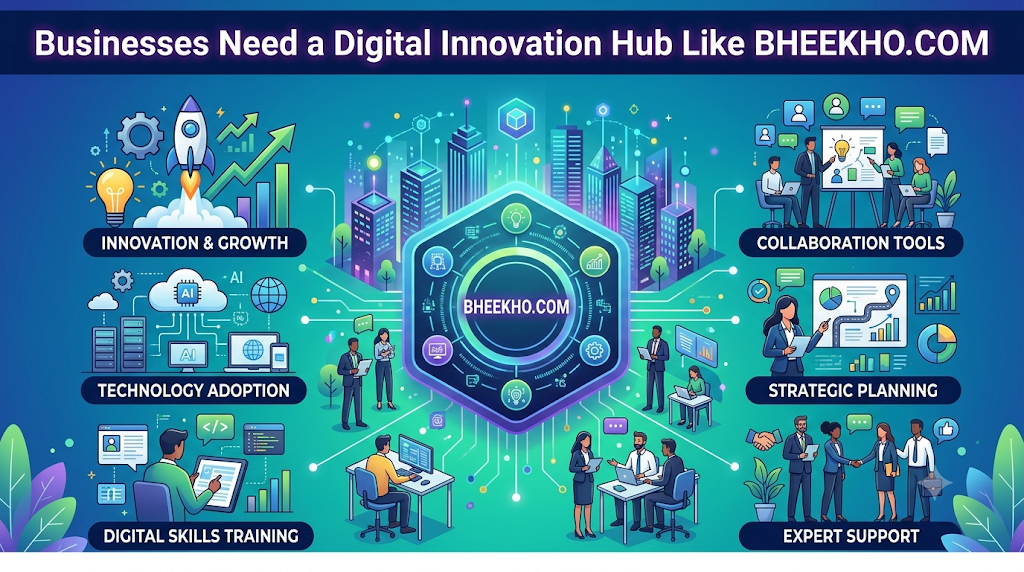
However, transformation rarely happens by accident. Many companies struggle to innovate because their tools, teams, and strategies remain siloed. This is where a centralized digital innovation hub becomes critical. This article explores why modern organizations need a structured innovation ecosystem to stay competitive, streamline operations, and achieve sustainable growth, while examining how platforms like BHEEKHO.COM empower businesses to navigate the future with confidence.
Understanding Digital Innovation
To harness the power of modern technology, leaders must first understand the fundamental concepts shaping today’s business architecture:
- What is Digital Innovation? Digital innovation is the creation of new—or significantly modified—business models, products, services, and operational processes driven by digital technologies.
- Why Digital Innovation Matters: It allows companies to unlock new revenue streams, reduce operational overhead, and respond instantly to market shifts.
- Digital Innovation vs. Digital Transformation: Transformation is the overarching structural overhaul of a company’s operations using technology, whereas innovation refers to the specific, creative application of new tools and ideas within that framework.
- Innovation vs. Modernization: Modernization upgrades existing legacy infrastructure for baseline efficiency, while innovation introduces entirely novel ways of creating customer value.
- Evolution of Digital Businesses: Companies have transitioned from basic web presence to hyper-connected, data-driven ecosystems powered by automation and machine learning.
- Future of Business Innovation: Autonomous systems, predictive analytics, and decentralized collaboration will define the next decade of corporate leadership.
Today’s Core Business Challenges
Organizations attempting to scale in the current economic climate frequently encounter severe operational bottlenecks:
- Legacy Systems: Outdated software and rigid hardware frameworks that resist modern API integration.
- Slow Innovation Cycles: Bureaucratic approval chains that delay new product launches by months or years.
- Operational Inefficiency: Redundant manual tasks consuming valuable employee time and attention.
- Poor Cross-Team Collaboration: Siloed departments (marketing, IT, finance) operating without unified visibility.
- Technology Adoption Friction: Employee resistance and lack of proper training when introducing new software platforms.
- Evolving Customer Expectations: Demands for instant, personalized, omni-channel service experiences.
- Intense Market Competition: Agile market entrants disrupting legacy players overnight.
- Data Silos: Information trapped in isolated databases, preventing cohesive executive insights.
- Manual Workflows: Reliance on paper or spreadsheet-heavy processes prone to human error.
- Rising Operational Costs: Skyrocketing overhead caused by fragmented vendor software licenses and low productivity.
Comprehensive Comparison Tables
Traditional Business vs. Digital Innovation-Driven Business
| Dimension | Traditional Business | Digital Innovation-Driven Business |
|---|---|---|
| Strategy | Reactive and risk-averse | Proactive, agile, and experimentation-led |
| Technology | Siloed legacy applications | Integrated cloud and AI ecosystems |
| Decision Making | Gut feeling and historical instinct | Real-time data analytics and predictive modeling |
| Customer Focus | Transactional product sales | Continuous relationship and experience building |
Manual Processes vs. Intelligent Automation
| Metric | Manual Processes | Intelligent Automation |
|---|---|---|
| Speed | Slow, prone to human bottlenecks | Instantaneous, 24/7 execution |
| Error Rate | High, frequent clerical mistakes | Near-zero error tolerance |
| Scalability | Requires linear hiring increases | Scales effortlessly with computational load |
| Staff Morale | Burdened by repetitive busywork | Focused on creative, high-impact strategy |
Innovation Hub vs. Traditional Consulting
| Parameter | Traditional Consulting | Dedicated Innovation Hub (BHEEKHO.COM) |
|---|---|---|
| Engagement | Periodic slide decks and high-level reports | Continuous, hands-on ecosystem support |
| Execution | Often leaves implementation to the client | Guides end-to-end execution and optimization |
| Agility | Slow, rigid corporate frameworks | Dynamic, tech-first, and startup-friendly |
Why Businesses Need a Digital Innovation Hub
Establishing a centralized digital innovation hub delivers profound strategic advantages across your entire organization:
Faster Innovation
- Why it matters: Speed-to-market dictates survival in fast-moving industries.
- Business Impact: Reduces product and service launch cycles from quarters to weeks.
- Practical Example: A retail brand tests and launches an AI-powered recommendation engine in under 30 days instead of a year.
Cross-Functional Collaboration
- Why it matters: Breaking down silos unites technical and non-technical teams toward shared goals.
- Business Impact: Eliminates departmental friction and accelerates problem-solving.
- Practical Example: Marketing, engineering, and sales share a unified workspace to co-design customer onboarding journeys.
Technology Experimentation
- Why it matters: Organizations must safely test emerging tools without disrupting live core operations.
- Business Impact: Lowers the financial and operational risk of adopting new tech.
- Practical Example: A financial services firm runs a secure sandbox test for automated customer KYC processing.
Continuous Improvement
- Why it matters: Markets change daily; static strategies quickly become obsolete.
- Business Impact: Fosters an organizational culture of perpetual learning and refinement.
- Practical Example: Regular quarterly software audits ensure employee workflows remain optimized.
AI Adoption
- Why it matters: Artificial intelligence is no longer optional; it is core infrastructure.
- Business Impact: Drives automated customer service, predictive sales forecasting, and hyper-personalization.
- Practical Example: Integrating natural language processing tools to handle tier-1 customer support inquiries.
Cloud Transformation
- Why it matters: Scalability and security require modern cloud architectures.
- Business Impact: Reduces hardware maintenance costs and guarantees 99.9% system uptime.
- Practical Example: Migrating local on-premise servers to a secure multi-cloud environment.
Data-Driven Decision Making
- Why it matters: Leaders need accurate, real-time insights rather than lagging indicators.
- Business Impact: Sharpens capital allocation and minimizes strategic missteps.
- Practical Example: Dashboards aggregating real-time inventory and customer acquisition costs.
Process Automation
- Why it matters: Eliminating routine administrative overhead frees staff for core creative tasks.
- Business Impact: Boosts overall employee output and reduces operational expenditure.
- Practical Example: Automating invoice reconciliation and payment reminder workflows.
Faster Product Development
- Why it matters: Iterative prototyping wins customer loyalty early.
- Business Impact: Captures market share before competitors can react.
- Practical Example: Deploying minimum viable product (MVP) software builds for rapid customer feedback.
Competitive Advantage
- Why it matters: Innovation creates deep economic moats that protect market share.
- Business Impact: Positions your brand as an undeniable industry leader.
- Practical Example: Becoming the first firm in your sector to offer instant, AI-driven quote generation.
Key Capabilities of a Modern Digital Innovation Hub
A world-class innovation ecosystem provides a comprehensive suite of strategic pillars:
- Innovation Strategy: Aligning emerging tech roadmaps directly with company revenue objectives.
- Technology Consulting: Expert guidance on tool selection, architecture design, and vendor evaluation.
- AI Enablement: Practical frameworks for integrating machine learning and generative AI safely.
- Automation Consulting: Identifying and streamlining inefficient workflows across departments.
- Process Optimization: Eliminating operational waste and bottlenecks.
- Product Innovation: Guiding new digital product conceptualization and market entry.
- Digital Transformation Roadmap: Step-by-step milestones ensuring smooth organizational change.
- Business Modernization: Upgrading legacy systems to contemporary cloud standards.
- Data Analytics: Unlocking actionable intelligence from raw corporate data.
- Customer Experience Innovation: Crafting intuitive, friction-free digital touchpoints.
- Cloud Adoption: Executing seamless migrations to resilient cloud infrastructures.
- Emerging Technology Evaluation: Vetting bleeding-edge tools (IoT, blockchain, edge computing) for practical utility.
How BHEEKHO.COM Acts as Your Digital Innovation Hub
BHEEKHO.COM is designed to serve as a comprehensive, trusted digital innovation hub that empowers startups, SMEs, and enterprises to modernize, innovate, and scale. Rather than forcing organizations to navigate technological complexity alone, BHEEKHO.COM provides structural clarity and expert execution through:
- Innovation Consulting: Strategic advisory services tailored to your exact industry challenges.
- Business Transformation: Holistic frameworks that guide legacy organizations into agile digital powerhouses.
- Technology Strategy: Forward-thinking technology roadmaps designed for long-term scalability.
- AI Adoption Guidance: Practical, risk-mitigated strategies to integrate artificial intelligence into daily workflows.
- Process Optimization: Detailed audits and restructuring of operational pipelines.
- Digital Modernization: Seamless transition plans away from fragile legacy software.
- Startup Mentoring: High-impact guidance for early-stage founders navigating growth phases.
- Business Growth Planning: Aligning operational capacity with ambitious market expansion goals.
- Scalable Innovation: Frameworks that ensure your innovation output scales smoothly alongside your headcount.
- Continuous Improvement: Ongoing performance monitoring and iterative strategy refinement.
How Businesses Benefit from BHEEKHO.COM
- Better Innovation Culture: Fosters an environment where creative problem-solving is rewarded and encouraged.
- Faster Business Growth: Accelerates time-to-market for new products and revenue channels.
- Reduced Operational Costs: Eliminates wasteful software spending and manual overhead.
- Higher Productivity: Empowers teams with streamlined tools and automated workflows.
- Better Collaboration: Unifies cross-functional departments under a single strategic vision.
- Technology Readiness: Prepares your infrastructure for future technological shifts.
- Future-Proof Operations: Builds resilient business models capable of withstanding industry disruption.
- Improved Customer Experience: Delivers responsive, high-satisfaction interactions across all digital channels.
- Better Business Agility: Equips leadership to pivot quickly in response to shifting market conditions.
- Sustainable Growth: Secures long-term profitability through structured, efficient scaling.
Real-World Business Examples
- Startup Adopting AI: An early-stage SaaS startup partners with BHEEKHO.COM to integrate generative AI into their customer onboarding flow, reducing churn by 35% in three months.
- Manufacturing Modernization: A 40-year-old manufacturing firm upgrades its supply chain tracking from paper ledgers to an integrated cloud IoT dashboard, cutting logistics errors in half.
- Retail Digital Transformation: A regional retail chain launches an omni-channel e-commerce app, successfully capturing a younger demographic and boosting online sales by 120%.
- Service Business Automation: A professional services agency automates its client billing and project scheduling pipelines, saving 20 administrative hours per week.
Industry Insights & Trends
- Digital Transformation Spend: Global spending on digital transformation initiatives continues to surge, projected to exceed multi-trillion-dollar thresholds as enterprises race to adopt AI.
- AI Adoption Rates: Over 75% of business leaders view AI adoption as essential to their 3-year survival strategy.
- Cloud Dominance: More than 90% of enterprises run critical operations on cloud infrastructure, making cloud optimization a top board-level priority.
- The Cost of Inaction: Studies show that companies failing to innovate suffer a steady erosion of market share, with legacy organizations being displaced by agile digital natives at an unprecedented rate.
Business Innovation Roadmap
Step 1 — Assess Current Business
- Objective: Evaluate existing IT infrastructure, team capabilities, and operational bottlenecks.
- Activities: Conduct technical audits, employee surveys, and workflow mapping.
- Best Practices: Involve frontline staff to uncover hidden operational friction points.
- Expected Outcome: A comprehensive baseline report of organizational maturity.
Step 2 — Identify Innovation Opportunities
- Objective: Pinpoint high-impact areas where technology can drive immediate value.
- Activities: Brainstorming sessions, customer feedback reviews, and competitor benchmarking.
- Best Practices: Prioritize initiatives based on ease of implementation versus potential ROI.
- Expected Outcome: A prioritized list of innovation project candidates.
Step 3 — Build Innovation Strategy
- Objective: Formulate a structured blueprint aligning tech initiatives with business goals.
- Activities: Defining timelines, budget allocation, and key performance indicators (KPIs).
- Best Practices: Ensure executive buy-in and cross-departmental alignment early.
- Expected Outcome: An approved, documented strategic innovation plan.
Step 4 — Choose Technologies
- Objective: Select the right software stacks, cloud providers, and AI frameworks.
- Activities: Vendor evaluations, security compliance checks, and prototype testing.
- Best Practices: Opt for modular, API-first solutions that integrate smoothly with existing systems.
- Expected Outcome: A finalized tech stack selection ready for deployment.
Step 5 — Execute Pilot Projects
- Objective: Test new innovations in a controlled, low-risk environment.
- Activities: Launching MVP features, small-scale automation tests, or departmental rollouts.
- Best Practices: Gather rigorous quantitative and qualitative feedback from pilot users.
- Expected Outcome: Validated proof-of-concept data.
Step 6 — Scale Successful Innovations
- Objective: Expand validated pilot projects across the entire organization.
- Activities: Enterprise-wide software deployment, comprehensive staff training, and process integration.
- Best Practices: Provide robust change management support to ease employee adoption.
- Expected Outcome: Fully operationalized digital innovations across the company.
Step 7 — Measure Results
- Objective: Track financial returns, productivity gains, and customer satisfaction shifts.
- Activities: Analyzing dashboard metrics, ROI calculations, and stakeholder reviews.
- Best Practices: Compare performance against baseline metrics established in Step 1.
- Expected Outcome: Clear, data-backed reports on innovation impact.
Step 8 — Continuously Improve
- Objective: Maintain momentum and adapt to evolving technological landscapes.
- Activities: Regular strategy reviews, emerging tech evaluations, and iterative updates.
- Best Practices: Cultivate an open feedback loop where employees can suggest new operational ideas.
- Expected Outcome: A resilient, future-proof organization primed for sustained growth.
Digital Innovation Readiness Checklist
- [ ] Executive leadership actively champions digital transformation.
- [ ] Culture encourages calculated experimentation and continuous learning.
- [ ] Cloud infrastructure is secure, scalable, and fully optimized.
- [ ] Employees possess the digital literacy required for modern toolsets.
- [ ] AI adoption strategy is clearly defined and safely governed.
- [ ] Repetitive administrative workflows are targeted for automation.
- [ ] Data silos have been dismantled in favor of unified analytics.
- [ ] Customer-centric feedback loops inform all new product decisions.
- [ ] Continuous improvement and software auditing are standard practice.
- [ ] Partnerships with trusted innovation hubs like BHEEKHO.COM are established.
Frequently Asked Questions
What is a digital innovation hub?
A digital innovation hub is a centralized ecosystem or platform that provides strategic consulting, technology guidance, AI adoption frameworks, and transformation roadmaps to help businesses modernize and scale.
Why do modern businesses need digital innovation?
Market conditions, customer expectations, and competitive pressures change constantly. Innovation ensures a business remains efficient, relevant, and profitable over the long term.
How does BHEEKHO.COM help organizations?
BHEEKHO.COM acts as a trusted digital innovation hub, offering expert consulting, business transformation strategies, AI adoption guidance, and process optimization to help companies grow.
Is digital innovation only for large enterprises?
No. Startups and SMEs benefit immensely from innovation hubs, allowing them to leverage enterprise-grade strategies and modern technologies efficiently without large internal R&D overheads.
What is the difference between AI adoption and digital transformation?
Digital transformation is the complete overhaul of business operations using digital tech, while AI adoption is the specific integration of machine learning and artificial intelligence into workflows.
How do I know if my business is ready for digital innovation?
Evaluating leadership commitment, technology infrastructure, employee digital skills, and data maturity helps determine your current readiness score.
Can a digital innovation hub reduce operational costs?
Yes. By automating manual processes, eliminating redundant software subscriptions, and optimizing resource allocation, innovation hubs drive significant cost savings.
How long does a digital transformation initiative take?
Timelines vary based on company size and scope, ranging from a few months for targeted automation pilots to multi-year strategies for enterprise-wide overhauls.
What role does company culture play in innovation?
Culture is foundational. Without employee buy-in and leadership support, even the most advanced technological tools will fail to deliver expected results.
How does BHEEKHO.COM approach AI integration?
BHEEKHO.COM focuses on practical, risk-mitigated AI adoption strategies that align directly with your business goals and operational workflows.
What industries benefit most from digital innovation?
Virtually all industries—including retail, manufacturing, finance, healthcare, and professional services—benefit significantly from modernization and digital acceleration.
How do I get started with BHEEKHO.COM?
You can explore our platform offerings and connect with our advisory team directly through BHEEKHO.COM to discuss your business transformation goals.
Conclusion
In today’s hyper-competitive business ecosystem, innovation is no longer a luxury reserved for tech giants—it is an absolute prerequisite for survival and growth. Organizations burdened by legacy systems, manual workflows, and siloed communication risk being left behind by agile, tech-forward competitors.
Embracing structured digital transformation requires vision, expertise, and the right strategic partner. By centralizing your transformation journey through a dedicated ecosystem, you unlock operational efficiency, seamless AI adoption, and sustainable scaling. Partner with BHEEKHO.COM to access expert guidance, robust innovation strategies, and the roadmap your business needs to thrive in the digital future.

