
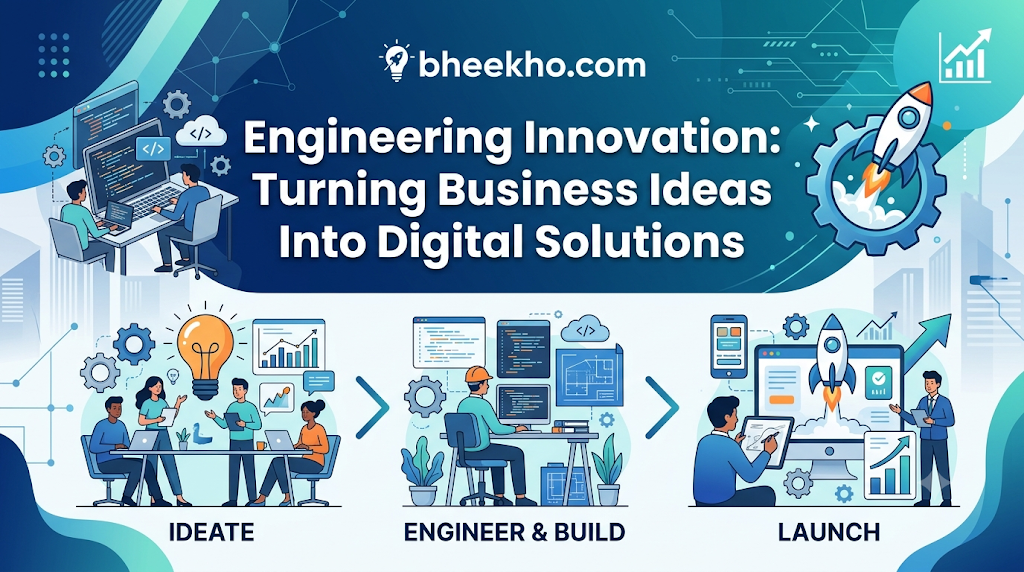
Introduction
In today’s hyper-connected, digital-first economy, raw concepts are a commodity. The real differentiator between a market leader and a forgotten venture lies in execution. Data indicates that over 70% of digital transformation initiatives fail to meet their intended ROI, and up to 90% of startups collapse within their first few years. These failures rarely stem from poor concepts; they are caused by fragmented execution, inadequate architecture, and a failure to align digital product development with market realities.
Transforming a raw vision into a functional ecosystem requires deep strategic planning, exhaustive validation, robust technology selection, and precise implementation. This guide explores the architectural pathway from abstract concepts to production-grade applications. We will break down operational models, isolate systematic traps, and outline the precise blueprint for sustainable market entry.
Understanding Digital Business Ideas
A digital business idea is not simply a traditional business workflow translated onto a screen. It is a systematic framework designed to solve structural market friction by leveraging scalable computing, automated workflows, and data networks.
[Raw Friction Point] ──> [Scalable Computing + Data Networks] ──> [Value Generation Engine]
True digital innovations do not just replicate analog habits; they fundamentally redesign the value chain. For instance, when analyzing a modern enterprise software concept, an idea must be evaluated by its structural components:
- The Value Generation Engine: How the software reduces transaction friction, operational costs, or processing times.
- The Data Lifecycle: How user activity feeds back into predictive models to create a self-improving platform.
- The Scale Architecture: The operational efficiency achieved when serving ten thousand concurrent transactions compared to a single manual operation.
Why Great Ideas Need the Right Execution
Execution is the mechanism that translates speculative business assumptions into empirical system metrics. A concept on paper operates under perfect, unverified conditions. When introduced to live production, that concept encounters real-world complexities: unexpected system dependencies, fluid user behavior, data corruption risks, and variable network performance.
Speculative Concept (Perfect Conditions) ──[Execution Blueprint]──> Live Production (Market Realities)
Without a structured implementation strategy, technical debt accumulates rapidly. Teams often fall into the trap of over-engineering non-essential microservices before verifying that the product actually addresses user needs. Conversely, they may build fragile codebases that collapse under sudden spikes in user traffic.
True digital product development requires balancing immediate market validation against long-term architectural stability. This balance ensures the software can evolve seamlessly as the business grows.
Common Challenges Entrepreneurs Face
The path to digital modernization is filled with structural obstacles. Startups, SMEs, and enterprise units often struggle with identical execution errors, regardless of their scale:
- Technical Debt Accommodation: Rushing code to market without architectural oversight leads to fragile systems. Eventually, adding new features becomes prohibitively expensive.
- Misaligned Product-Market Verification: Building comprehensive software platforms based entirely on unverified internal assumptions, rather than real-world customer insights.
- Talent Fragility and Fragmented Ecosystems: Managing disparate engineering teams, design agencies, and marketing consultants creates communication gaps and fragmented project ownership.
- Inflexible Resource Allocation: Spending excessive capital on initial infrastructure before validating core value propositions, leaving the business with minimal resources to adapt or scale later.
Comparative Landscapes: Strategic Architecture Planning
To build a sustainable digital asset, leaders must shift from reactive management to deliberate, digital-first strategic planning. The following comparative blueprints illustrate the differences between outmoded operational strategies and optimized modern implementations.
Traditional Business Development vs. Digital-First Development
| Metric / Dimension | Traditional Business Development | Digital-First Development |
| Market Entry Velocity | Multi-month/year linear waterfall timelines with static deployment gates. | Continuous integration, rapid minimum viable product (MVP) releases, and iterative improvements. |
| Infrastructure Layout | High upfront capital expenditure on hardware, physical systems, and local servers. | Elastic cloud deployment models focused on flexible operational expenditure. |
| Feedback Loop Integration | Retrospective quarterly reviews, manual surveys, and delayed financial auditing. | Real-time event logging, behavior tracking, automated analytics, and user monitoring. |
| Scalability Mechanics | Linear operational cost increases requiring corresponding additions to headcount. | Asymptotic operational efficiency driven by automated software scaling. |
Business Idea vs. Digital Solution
| Dynamic Attribute | The Raw Business Idea | The Fully Realized Digital Solution |
| State of Certainty | Hypothetical assumptions regarding user behavior and target market dynamics. | Empirically verified codebases operating against live user interactions. |
| Risk Environment | Unquantified market, operational, and financial risks. | Managed, mitigated engineering challenges backed by automated rollbacks and fallback systems. |
| Operational State | Passive documentation, slide decks, and abstract concept notes. | Active API endpoints, transactional ledgers, and live user databases. |
| Value Position | Speculative potential value subject to market interest. | Realized operational asset delivering quantifiable, repeatable efficiencies. |
Manual Processes vs. Digital Automation
| Operational Vector | Manual Legacy Workflows | Automated Digital Orchestration |
| Error Frequency Rate | Variable human error margins across data input, calculation, and document routing. | Deterministic execution paths with comprehensive exception logging. |
| Processing Velocity | Constrained by human work hours, physical handoffs, and operational silos. | Near-instantaneous execution handling concurrent batch data flows 24/7. |
| Data Transparency | Fragmented across physical document stores, custom spreadsheets, and local drives. | Centralized relational databases providing a single source of truth accessible via secure APIs. |
| Organizational Cost | Scales linearly with transaction volume, requiring constant hiring to manage growth. | Fixed baseline infrastructure costs that distribute efficiently as volume increases. |
Startup Challenges vs. Technology Solutions
| Identified Structural Challenge | Strategic Engineering Solution |
| Premature Platform Scalability Crises | Decoupled microservices architecture combined with automated serverless scaling limits. |
| Feature Creep & Resource Exhaustion | Strict MVP scoping focused entirely on high-value user pathways. |
| Data Fragmentation & Security Silos | Centralized data lakes managed via strong identity and access management (IAM) rules. |
| High Churn & Low User Retention | Automated event tracking linked to data-driven UX adjustments. |
Short-Term Thinking vs. Long-Term Digital Strategy
| Strategy Paradigm | Short-Term Tactical Patching | Long-Term Digital Transformation |
| Architectural Vision | Point-to-point hardcoded integrations designed for immediate deployment. | Modular, API-first architecture designed for long-term interoperability. |
| Security Lifecycle | Reactive patch application following security vulnerabilities or data breaches. | Proactive DevSecOps integration with automated dependency vulnerability scanning. |
| Data Asset Strategy | Disposable logs treated as operational waste or simple troubleshooting tools. | Structured data analytics driving automated predictive algorithms and business intelligence. |
| Vendor Interdependency | Proprietary lock-in due to non-standard code modifications and custom languages. | Open standard compliance combined with containerized multi-cloud deployment strategies. |
From Concept to Digital Product
Moving from an abstract concept to a production-grade digital solution requires a systematic framework that eliminates guesswork. The evolution follows a clear path:
[Abstract Concept] ──> [Functional Validation] ──> [Interactive Blueprint] ──> [Production-Grade Solution]
- Functional Validation: Deconstructing the original idea to its core value proposition. Every proposed feature must directly address a verified user pain point.
- Interactive Blueprinting: Building wireframes and structural prototypes to map the user journey, ensuring the interface is intuitive and friction-free.
- Production Engineering: Translating the validated design into clean, scalable code. This stage focuses on setting up robust database models, secure APIs, and reliable infrastructure that allows the product to grow seamlessly alongside the business.
The Importance of Innovation and Technology
Modern software engineering provides powerful tools that allow businesses to build highly scalable digital platforms:
- Cloud Architecture & Elasticity: Platforms utilize serverless computing and dynamic container management (such as Kubernetes) to automatically adjust resources based on live traffic, minimizing operational costs.
- Artificial Intelligence & Predictive Engines: Machine learning models process large volumes of operational data to automate complex decisions, predict customer behavior, and optimize internal workflows.
- Unified API Ecosystems: Designing software with an API-first approach ensures different applications can connect and exchange data seamlessly, breaking down information silos across the organization.
Digital Transformation for Modern Businesses
Digital transformation is not simply about upgrading legacy hardware or moving storage to the cloud. True modernization reshapes how an organization delivers value, uses data, and automates core processes.
Legacy Operations (Manual, Siloed Data) ──[Modernization Process]──> Optimized Digital Ecosystem (Automated, Insights-Driven)
By connecting legacy systems with modern cloud infrastructure, businesses can turn unorganized operational logs into actionable business intelligence. Automation replaces repetitive manual workflows with self-correcting software pipelines, freeing up teams to focus on strategic growth and innovation.
Why Businesses Need Strategic Technology Partners
Building complex modern software requires deep expertise across multiple technical disciplines, including cloud infrastructure design, data security, user experience planning, and agile project management. For most businesses, maintaining an elite in-house team across all these specialties is financially impractical.
Partnering with an innovation consultancy like BHEEKHO.COM provides instant access to structured engineering frameworks and specialized technical talent. This collaboration allows organizations to avoid common development pitfalls, keep project timelines on track, and ensure their technology investments deliver clear business results.
Introduction to BHEEKHO.COM
BHEEKHO.COM serves as a premier technology consulting and digital transformation services provider, built to bridge the gap between ambitious business goals and scalable software reality. The organization provides comprehensive product development, strategic consulting, and process automation solutions tailored for startups, expanding SMEs, and modern enterprises.
By combining deep technical expertise with commercial strategy, BHEEKHO.COM ensures that client systems are not only robust and highly secure but also perfectly aligned with long-term business objectives.
BHEEKHO.COM’s Mission and Innovation Philosophy
At the core of BHEEKHO.COM’s operational philosophy is a clear principle: Technology must serve as a direct driver of business growth, not an ongoing cost center. The company reject one-size-fits-all software templates and superficial technical updates.
The team focuses on building modular, adaptable software structures designed to evolve alongside changing market demands. BHEEKHO.COM prioritizes iterative validation, architectural transparency, and clean, high-performance code, ensuring that every digital asset created delivers measurable business value and a clear return on investment.
How BHEEKHO.COM Turns Business Ideas Into Digital Solutions: A Deep Dive
The operational framework utilized by BHEEKHO.COM breaks down complex development cycles into structured, predictable phases. This end-to-end approach ensures every digital product is built with high precision, clear strategic purpose, and solid architectural integrity.
Idea Discovery ──> Market Research ──> Business Validation ──> Digital Strategy ──> Technology Planning ──> UX/UI Planning ──> Product Development ──> Testing & QA ──> Launch Strategy ──> Continuous Improvement ──> Business Scaling
Stage 1: Idea Discovery
- Objective: Uncover the foundational mechanics of the client’s concept and isolate the core market problem.
- Process: Conduct intensive collaborative sessions to map out assumptions, user archetypes, and desired business outcomes.
- Key Activities: Create comprehensive mind maps, list functional requirements, and identify legacy system dependencies.
- Business Benefits: Aligns stakeholder expectations early on and prevents costly scope creep during later development cycles.
- Expected Outcomes: A verified Idea Discovery Document defining project boundaries and clear business goals.
- Best Practices: Focus heavily on identifying the underlying problem before discussing specific features or technology stacks.
Stage 2: Market Research
- Objective: Validate the target audience demographics and map the competitive landscape.
- Process: Gather open-source intelligence, evaluate competitor offerings, and analyze user behavioral trends.
- Key Activities: Conduct deep competitor feature reviews, analyze market share distribution, and identify underserved user groups.
- Business Benefits: Lowers market entry risks by identifying gaps in competitor products and uncovering unique differentiation opportunities.
- Expected Outcomes: A comprehensive Market Competitiveness Report backed by real-world industry data.
- Best Practices: Use precise data analytics tools rather than relying on generalized, superficial market reports.
Stage 3: Business Validation
- Objective: Structurally verify the commercial viability and financial feasibility of the proposed product model.
- Process: Apply empirical stress testing to monetization models against current customer acquisition costs (CAC) and lifetime value (LTV) dynamics.
- Key Activities: Formulate unit economic matrices, draft financial projection frameworks, and execute proof-of-concept interviews.
- Business Benefits: Protects investment capital from being deployed into systems lacking sustainable long-term market demand.
- Expected Outcomes: A verified Economic Feasibility Model containing formal risk assessments.
- Best Practices: Validate consumer willingness-to-pay early through data-backed smoke testing and targeted landing page conversions.
Stage 4: Digital Strategy
- Objective: Formulate a cohesive operational roadmap that connects technical execution directly with overarching corporate growth goals.
- Process: Align long-term business goals with phased software feature releases across targeted development timelines.
- Key Activities: Map the entire product evolution path, define clear Key Performance Indicators (KPIs), and plan out phased releases.
- Business Benefits: Guarantees that every development sprint builds directly toward the company’s long-term commercial goals.
- Expected Outcomes: A dynamic Digital Strategy Blueprint outlining clear, phased development milestones.
- Best Practices: Maintain a highly flexible strategy model capable of adapting swiftly to live market performance metrics.
Stage 5: Technology Planning
- Objective: Design a secure, highly scalable, and cost-effective systems architecture tailored to the product’s needs.
- Process: Select optimized programming languages, database systems, cloud infrastructure providers, and integration approaches.
- Key Activities: Create detailed data schema models, design API communication layouts, and establish cloud security protocols.
- Business Benefits: Prevents early technical choices from limiting future growth, while minimizing unnecessary ongoing server and cloud infrastructure costs.
- Expected Outcomes: A comprehensive Technical Architecture Specification detailing all system data flows.
- Best Practices: Prioritize decoupled, API-first structures to ensure the system remains highly adaptable over time.
Stage 6: UX/UI Planning
- Objective: Maximize user task completion speeds while minimizing cognitive friction across all digital touchpoints.
- Process: Translate functional software requirements into highly intuitive, user-friendly interactive visual interfaces.
- Key Activities: Create structural user flow diagrams, build wireframes, and develop interactive user experience prototypes.
- Business Benefits: Boosts day-one user adoption rates and significantly lowers ongoing customer support costs caused by interface confusion.
- Expected Outcomes: High-fidelity, developer-ready interactive design mockups accompanied by verified design asset libraries.
- Best Practices: Base user interface paths on data-driven design standards rather than subjective visual preferences.
Stage 7: Product Development
- Objective: Write clean, modular, and highly performant production-ready code that matches the technical specification.
- Process: Execute disciplined, agile development sprints supported by automated continuous integration and deployment (CI/CD) pipelines.
- Key Activities: Code core backend logic, build responsive frontend layouts, and establish secure third-party service connections.
- Business Benefits: Delivers highly functional software increments reliably, giving stakeholders clear visibility into real development progress.
- Expected Outcomes: Securely managed, fully documented code repositories containing deployment-ready application builds.
- Best Practices: Enforce strict automated linting rules and require multi-engineer peer code reviews for all production additions.
Stage 8: Testing & Quality Assurance
- Objective: Ensure complete system stability, high performance under load, and comprehensive security protection across the codebase.
- Process: Run automated unit tests alongside rigorous manual testing to verify performance, data integrity, and vulnerability resistance.
- Key Activities: Execute automated API load testing, run cross-browser UI checks, and conduct deep penetration testing.
- Business Benefits: Protects brand reputation and prevents revenue loss by eliminating critical bugs prior to public release.
- Expected Outcomes: A certified Quality Assurance Compliance Audit confirming the platform is fully ready for deployment.
- Best Practices: Integrate automated security scanning directly into the deployment pipeline to catch issues early.
Stage 9: Launch Strategy
- Objective: Deploy the completed system to production environments seamlessly without disrupting ongoing business operations.
- Process: Execute coordinated cloud environment provisioning alongside automated database schema updates and live traffic switching.
- Key Activities: Set up real-time server monitoring tools, establish operational alert systems, and deploy data backup mechanisms.
- Business Benefits: Minimizes user-facing downtime during major updates and ensures immediate recovery options are available if errors occur.
- Expected Outcomes: A live production environment running stable software accessible to global users.
- Best Practices: Implement gradual blue-green deployment strategies to verify platform updates on a subset of live traffic first.
Stage 10: Continuous Improvement
- Objective: Refine application usability and optimize system performance using real-world operational data.
- Process: Monitor ongoing user interaction paths and system health logs to identify and resolve performance bottlenecks.
- Key Activities: Analyze heatmaps and user drop-off points, tune database queries, and fix user-reported edge-case bugs.
- Business Benefits: Keeps user engagement high by systematically upgrading features based on actual software usage patterns.
- Expected Outcomes: Regular, optimized update releases that steadily improve core business performance metrics.
- Best Practices: Prioritize development work based on hard usage metrics rather than unsubstantiated feature requests.
Stage 11: Business Scaling
- Objective: Support high volumes of concurrent users and expand platform capabilities without losing performance or reliability.
- Process: Transition application components to fully dynamic cloud environments and modular microservices architecture models.
- Key Activities: Configure cross-region database replication, implement intelligent data caching layers, and modularize large codebases.
- Business Benefits: Allows the business to capture massive market opportunities smoothly, keeping application performance fast as transaction volumes spike.
- Expected Outcomes: A highly resilient, distributed software infrastructure optimized for large-scale enterprise performance.
- Best Practices: Design software systems horizontally from day one to ensure adding computing resources remains simple and linear.
Practical Examples: Turning Frameworks Into Business Outcomes
To understand how these phases function in practice, let us examine real-world implementations across various business environments.
1. Startup Idea Validation
An aspiring fintech team aimed to launch an automated invoice-factoring platform for supply chain vendors. Instead of immediately writing code, BHEEKHO.COM designed a high-fidelity interactive prototype linked to an analytics dashboard.
We ran targeted user testing with fifty supply chain financial officers. The data revealed that users did not want a complex asset-management dashboard; they simply needed an instant, single-button approval widget that integrated with their existing ERP. This early validation saved the startup nine months of unnecessary development work and directed their funding toward a highly validated, high-value core product.
2. Digital Product Development Journey
A logistics firm operated its global fleet using manual spreadsheets, radio communications, and paper manifests. BHEEKHO.COM systematically moved these legacy workflows into a custom cloud-based fleet orchestration platform.
[Manual Spreadsheets & Paper Manifests] ──(BHEEKHO.COM Engineering)──> [Unified Real-Time Fleet Dashboard]
We replaced manual driver dispatches with an automated routing engine that recalculates pickup priority based on live traffic data and fuel consumption. The platform includes a responsive mobile portal for drivers and an automated dashboard for operators, giving management real-time visibility into fleet operations and lowering total fuel costs by 22% within the first two quarters.
3. Business Process Automation Example
A major real estate management corporation handled tenant maintenance requests via manual email processing and phone intake. This led to slow response times, missed requests, and high operational overhead.
BHEEKHO.COM engineered an automated event-driven processing system. Now, incoming requests are parsed using language processing models, automatically cross-referenced against active tenant contracts, and assigned directly to the nearest qualified technician via a custom mobile application. This automation cut maintenance operational costs by 41% and reduced average issue resolution times from days to under two hours.
Digital Solutions Offered by BHEEKHO.COM
BHEEKHO.COM provides a comprehensive suite of digital engineering capabilities designed to support organizations at every stage of their modernization journey.
- Digital Transformation Consulting: We evaluate your operational processes to eliminate communication silos, modernize legacy infrastructure, and build high-performance technology frameworks aligned with your business goals.
- Business Process Automation: We design automated workflows that handle complex data entry, trigger event-driven alerts, and manage routine compliance tasks, reducing operational errors and overhead.
- Software Development Services: We build highly secure, custom software architectures utilizing modern programming practices to address your organization’s unique operational needs.
- Web Solutions: We engineer responsive, high-traffic enterprise web platforms focused on fast load times, robust data protection, and flawless user experiences across all devices.
- Mobile Application Development: We build native and cross-platform mobile apps for iOS and Android that deliver fast performance and intuitive interfaces for your users.
- Cloud Solutions: We design flexible, secure multi-cloud architectures that lower ongoing infrastructure costs while protecting data through automated backup and recovery systems.
- AI & Emerging Technologies: We integrate secure machine learning models and predictive analytics engines directly into your business workflows to unlock data-driven insights and smarter automation.
- Business Intelligence: We transform messy, fragmented operational logs into clear, interactive analytical dashboards that give leadership teams the data they need to make strategic decisions.
- Customer Experience Solutions: We rebuild customer touchpoints into fast, frictionless digital journeys that improve user satisfaction and increase long-term customer retention.
- Digital Growth Strategy: We look beyond initial product deployment to help you establish scalable customer acquisition paths, optimize conversions, and build long-term value.
Why Businesses Choose BHEEKHO.COM
┌─────────────────────────────────────────────────────────────────┐
│                   THE BHEEKHO.COM ADVANTAGE                    │
├────────────────────────────────┬────────────────────────────────┤
│ 💡 Innovation-Driven Design    │ 🤝 Partnership Over Project    │
├────────────────────────────────┼────────────────────────────────┤
│ 📊 Quantifiable ROI Tracked     │ 🔒 DevSecOps Security Standard │
└────────────────────────────────┴────────────────────────────────┘
Organizations partner with BHEEKHO.COM because we replace typical vendor uncertainty with reliable, structured engineering processes:
- Innovation-Driven Design: We focus on building modern, forward-looking software architectures that give you a distinct competitive advantage, rather than just delivering basic functional checklists.
- Partnership Over Project Mindset: We view ourselves as an extension of your leadership team, remaining actively involved in long-term strategy well after the initial code deployment.
- Quantifiable ROI Tracked: We align our development cycles with clear business metrics, ensuring every technical update delivers tangible improvements to your operational efficiency or bottom line.
- DevSecOps Security Standard: We integrate advanced encryption, strict access controls, and automated vulnerability scanning directly into our core development pipelines to protect your business data from day one.
Building Future-Ready Digital Businesses
To remain competitive over the long term, software assets must be built to adapt to shifting market realities without requiring complete architectural rewrites. BHEEKHO.COM ensures your systems are future-ready by strictly adhering to open data standards, building decoupled API layers, and utilizing modular cloud-native infrastructure. This flexibility allows your platforms to adopt new technical capabilities seamlessly, scale up configuration capacity efficiently, and evolve smoothly as your business scales.
Emerging Trends in Digital Innovation
As technology continues to evolve rapidly, staying ahead requires keeping an eye on the architectural shifts reshaping the global digital economy:
- Edge Computing Integration: Shifting computational workloads from central cloud servers closer to the network edge, enabling near-instantaneous processing for real-time mobile and IoT systems.
- Advanced LLMs & Context-Aware Automation: Moving beyond simple keyword matching to deploy intelligent AI models capable of understanding complex user intent and securely automating multi-step operational tasks.
- Zero-Trust Security Architectures: Shifting away from basic perimeter security models to enforce continuous identity verification and strict data encryption protocols at every layer of the system.
Business Idea to Digital Solution Roadmap
Transform your vision into a production-grade application by following this clear, step-by-step roadmap:
- Step 1: Define the Problem: Clearly isolate the specific user pain point you are trying to solve, ensuring your product addresses a genuine, verified market need.
- Step 2: Validate the Opportunity: Gather empirical evidence regarding user interest and willingness to pay before writing any production code.
- Step 3: Research the Market: Deeply analyze competitor strengths, weaknesses, and feature structures to identify clear opportunities for product differentiation.
- Step 4: Design the Solution: Map intuitive user flows and build interactive wireframe interfaces focused on removing cognitive friction.
- Step 5: Select the Right Technology Stack: Choose database models, language frameworks, and cloud architectures that ensure long-term stability and cost-effective scaling.
- Step 6: Build the MVP: Focus development entirely on building a high-performance version of your platform’s core value proposition.
- Step 7: Test with Real Users: Release the MVP to selected user groups to gather real-world performance data and feedback.
- Step 8: Launch the Product: Deploy the validated platform to live production environments using automated, zero-downtime deployment pipelines.
- Step 9: Measure Performance: Track critical system metrics, database response times, and key user retention analytics continuously.
- Step 10: Improve and Scale: Systematically optimize features and scale server capacity based on actual user interaction data.
Digital Innovation Readiness Checklist
Before moving your project into active development, use this checklist to ensure your business is fully aligned and ready for implementation:
- [ ] Business Goals: Core project success metrics are clearly defined and tied to tangible corporate growth outcomes.
- [ ] Customer Research: Target user archetypes have been verified through direct market observation and research data.
- [ ] Technology Readiness: Existing internal software systems have been audited for API compatibility and integration requirements.
- [ ] Budget Planning: Development capital is planned out across phased deployment cycles rather than spent entirely on the first release.
- [ ] Product Strategy: The initial MVP feature set is strictly scoped to prioritize solving the core user problem first.
- [ ] Digital Marketing: Scalable customer acquisition channels have been identified and prepared for the platform’s launch.
- [ ] Security Regulations: Necessary data protection rules (such as GDPR or HIPAA) are integrated into the technical design requirements.
- [ ] Scalability Plans: Cloud resource allocation limits are configured to scale automatically with sudden user traffic spikes.
- [ ] Performance Measurement: Real-time event logging and business analytics tracking tools are set up to capture usage data immediately.
- [ ] Continuous Innovation: A structured feedback workflow is established to turn live user insights into ongoing product improvements.
Frequently Asked Questions (FAQs)
What exactly does BHEEKHO.COM do?
BHEEKHO.COM is an elite digital transformation consultancy and technology solutions provider. We partner with businesses to transform raw commercial concepts into highly secure, scalable, and market-ready digital products.
How does BHEEKHO.COM help validate a business idea before development starts?
We help minimize your market risk by using structured discovery frameworks, detailed competitor market analyses, and high-fidelity prototype testing to verify user demand and commercial viability before you commit major development capital.
What is digital transformation, and why does my business need it?
Digital transformation involves integrating modern cloud infrastructure, data analytics, and automated workflows deep into your business operations. It replaces fragile manual processes with scalable software ecosystems to improve efficiency and open new avenues for growth.
How does BHEEKHO.COM ensure my software can scale as my business grows?
We build all platforms utilizing decoupled microservices architectures, open API standards, and automated cloud scaling environments. This ensures your systems handle transaction spikes efficiently while keeping your ongoing infrastructure costs optimized.
What industries does BHEEKHO.COM serve?
We deliver custom software engineering and digital transformation strategies across a broad spectrum of industries, including Fintech, Logistics, Real Estate, Healthcare, E-commerce, and Enterprise SaaS.
What is an MVP, and why should we start with one?
A Minimum Viable Product (MVP) is a launch-ready version of your software that focuses entirely on executing your core value proposition. Starting with an MVP allows you to gather live user data and feedback quickly, helping you avoid spending budget on unverified, non-essential features.
How long does the journey from business idea to digital solution typically take?
Timelines vary based on the overall complexity of the technical architecture. A highly focused initial MVP can often be validated, engineered, and launched within 8 to 12 weeks, while larger enterprise transformation projects follow broader phased schedules.
Does BHEEKHO.COM sign Non-Disclosure Agreements (NDAs) to protect my intellectual property?
Yes. We strictly enforce comprehensive intellectual property protections and sign mutual Non-Disclosure Agreements before discussing any proprietary business concepts or operational data.
Can BHEEKHO.COM integrate modern software with our legacy systems?
Yes. Our engineering teams specialize in building custom middleware layers and secure APIs that connect legacy database structures with modern cloud platforms, avoiding operational disruption.
Conclusion
In the modern digital economy, a great business idea is simply a starting point; sustainable success belongs to organizations that prioritize disciplined, long-term technical execution. Moving from an abstract concept to a high-performance digital solution requires clear market validation, smart strategic planning, and a strong, scalable software architecture.
Trying to navigate this complex development process alone often leads to expensive technical errors and delayed timelines. Partnering with an experienced innovation consultancy like BHEEKHO.COM gives your team access to the structured engineering practices and technical guidance needed to build sustainable digital products.

