
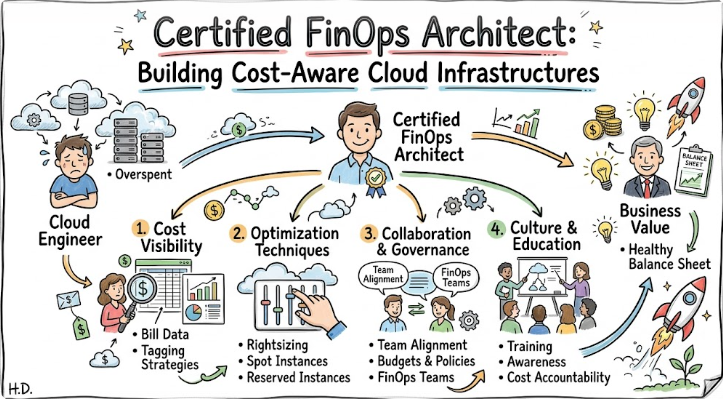
The Certified FinOps Architect is a comprehensive credential designed for professionals aiming to bridge the gap between cloud engineering and financial accountability. As cloud adoption continues to scale, organizations are shifting from simple cost monitoring to integrated financial operations. This guide is tailored for engineers, architects, and managers who need to understand how to design, implement, and maintain cost-efficient cloud infrastructures. Whether you are an SRE, a DevOps practitioner, or a platform engineer, Finopsschool provides the structured framework necessary to make informed architectural decisions that balance performance with expenditure. By following this roadmap, you can better navigate the complexities of cloud-native environments and advance your career by becoming a strategic asset to your organization.
What is the Certified FinOps Architect?
The Certified FinOps Architect represents a rigorous standard for professionals tasked with optimizing cloud spend within complex technical environments. It exists to move beyond basic dashboarding, focusing instead on deep architectural patterns, unit economics, and automated cost governance. This certification emphasizes practical, production-focused learning, ensuring that candidates can apply concepts directly to high-scale cloud deployments. It aligns perfectly with modern engineering workflows, where developers and architects are increasingly held accountable for the financial impact of their infrastructure choices. By mastering these competencies, professionals ensure that cloud environments are not only scalable and performant but also economically sustainable.
Who Should Pursue Certified FinOps Architect?
This certification is designed for a broad spectrum of technical professionals who are deeply integrated into the cloud ecosystem. It is ideal for Cloud Architects, DevOps Engineers, and Site Reliability Engineers who are responsible for designing infrastructure that meets both technical and budget requirements. Engineering managers and FinOps practitioners will also find immense value, as it equips them with the vocabulary and architectural knowledge to lead cost-optimization initiatives. Whether you are operating in the Indian tech landscape or a global enterprise, the ability to manage cloud costs with engineering precision is becoming a prerequisite for senior-level roles across all major cloud-native organizations.
Why Certified FinOps Architect is Valuable in Modern Engineering
As organizations shift toward more sophisticated cloud models, the ability to control financial variables is as critical as managing uptime or latency. The Certified FinOps Architect provides a framework that remains relevant even as specific tooling or cloud service providers evolve. It transforms cost management from a reactive accounting task into a proactive engineering discipline, which is highly sought after by leadership. For the individual, this certification serves as a career differentiator, signaling that you possess the rare combination of technical expertise and business acumen. Investing in this certification offers a high return by increasing your strategic value and long-term employability in an increasingly complex cloud market.
Certified FinOps Architect Certification Overview
The program is delivered via Certified FinOps Architect and is hosted on the FinOpsSchool platform. This certification takes a performance-oriented approach, focusing on the real-world application of architectural principles rather than rote memorization. It requires candidates to demonstrate proficiency in designing cloud architectures that adhere to both technical specifications and strict financial guardrails. The program structure ensures that participants gain experience in automated budgeting, cost-aware resource allocation, and advanced tagging strategies, preparing them for the realities of modern enterprise cloud operations.
Certified FinOps Architect Certification Tracks & Levels
The certification path is structured to support professional growth, ranging from foundational concepts to advanced architectural design. It includes specialized tracks that address the unique cost drivers associated with various cloud domains, such as Kubernetes, serverless architecture, and data-intensive workloads. These levels are mapped to your career progression, starting with basic cost-control methods and advancing to complex organizational governance. This tiered approach allows engineers to build a solid foundation before specializing in the areas of cloud infrastructure that most heavily impact their organization’s bottom line.
Complete Certified FinOps Architect Certification Table
| Track | Level | Who it’s for | Prerequisites | Skills Covered | Recommended Order |
| Core FinOps | Foundation | Cloud Beginners | Basic Cloud Knowledge | Cost Visibility, Tagging | 1 |
| Cloud FinOps | Professional | DevOps / SRE | Cloud Experience | Resource Optimization | 2 |
| Advanced Arch | Advanced | Architects / Leads | Professional Cert | Strategic Cost Planning | 3 |
Detailed Guide for Each Certified FinOps Architect Certification
Certified FinOps Architect – Foundation Level
What it is
This level validates your fundamental understanding of cloud cost models, billing structures, and the basic principles of visibility and reporting in cloud environments.
Who should take it
It is designed for cloud practitioners and early-career engineers who need a solid grounding in how cloud expenditures are tracked and managed.
Skills you’ll gain
- Understanding cloud billing APIs.
- Implementing resource tagging standards.
- Establishing basic cost alerts and budgets.
Real-world projects you should be able to do
- Create a monthly cloud cost dashboard.
- Establish a tagging policy for a dev environment.
- Configure automated budget alerts for specific departments.
Preparation plan
- 7 Days: Review cloud provider billing documentation and pricing models.
- 30 Days: Gain hands-on experience by auditing resources in a lab environment.
- 60 Days: Practice building comprehensive cost reports and setting up governance triggers.
Common mistakes
- Over-relying on default provider tools without custom tagging.
- Ignoring the importance of cultural buy-in regarding cost awareness.
- Focusing solely on tools rather than the underlying architecture.
Best next certification after this
- Same-track: Certified FinOps Architect – Professional Level.
- Cross-track: Certified Cloud Architect.
- Leadership: Cloud Financial Operations Management.
Choose Your Learning Path
DevOps Path
The DevOps path focuses on integrating cost-management into CI/CD pipelines. You will learn how to automate cost checks before infrastructure provisioning and how to use Infrastructure as Code to enforce financial guardrails.
DevSecOps Path
This track bridges the gap between security compliance and cost efficiency. It explores how security-related overhead, such as data encryption and threat monitoring, impacts resource utilization and how to optimize these costs without compromising integrity.
SRE Path
The SRE path centers on the relationship between reliability and cost. It covers how to balance Service Level Objectives (SLOs) with budget constraints, ensuring that performance requirements do not lead to runaway infrastructure expenditure.
AIOps Path
The AIOps track addresses the unique financial challenges of machine learning and large-scale data modeling. It focuses on optimizing expensive GPU/TPU instances and managing the costs of training versus inferencing cycles.
MLOps Path
This path specializes in the lifecycle of ML models, specifically how to manage the lifecycle costs of data storage, model retraining, and deployment versioning in cloud environments.
DataOps Path
The DataOps path focuses on the financial optimization of data pipelines and storage architectures. It explores how to manage costs associated with data ingestion, transformation, and cold storage long-term retention policies.
FinOps Path
The FinOps path is the holistic approach, covering organizational governance, unit economics, and cross-departmental collaboration. It prepares you to lead cost-optimization cultural shifts within an enterprise.
Role → Recommended Certified FinOps Architect Certifications
| Role | Recommended Certifications |
| DevOps Engineer | Certified FinOps Architect (Professional) |
| SRE | Certified FinOps Architect (Advanced) |
| Platform Engineer | Certified FinOps Architect (Professional) |
| Cloud Engineer | Certified FinOps Architect (Foundation) |
| Security Engineer | Certified FinOps Architect (Professional) |
| Data Engineer | Certified FinOps Architect (Professional) |
| FinOps Practitioner | Certified FinOps Architect (Advanced) |
| Engineering Manager | Certified FinOps Architect (Advanced) |
Next Certifications to Take After Certified FinOps Architect
Same Track Progression
Once you have mastered the architectural aspects of FinOps, the next logical step is to pursue deep specialization in niche areas such as Kubernetes cost optimization or serverless billing models. These advanced certifications focus on the complex interplay between container orchestration and cloud billing logic, allowing you to manage costs in highly dynamic and ephemeral environments.
Cross-Track Expansion
If you want to broaden your impact, consider cross-track certifications in Security or Site Reliability Engineering. By combining your FinOps knowledge with deep expertise in security or reliability, you become a “full-stack” architect capable of balancing the three pillars of modern cloud operations: cost, security, and performance.
Leadership & Management Track
For those transitioning into leadership, focus on certifications that emphasize governance, unit economics, and organizational change management. These programs help you shift your role from an individual contributor managing resources to a leader who influences organizational strategy and aligns cloud investment with business outcomes.
Training & Certification Support Providers for Certified FinOps Architect
DevOpsSchool offers comprehensive training programs designed for engineers who want to master architectural patterns, focusing on hands-on labs and real-world scenarios to ensure practical skill acquisition for every certification level.
Cotocus provides advanced mentorship and structured guidance, helping professionals navigate complex cloud environments while emphasizing the integration of financial discipline into traditional engineering and development workflows.
Scmgalaxy focuses on the intersection of version control, CI/CD, and financial operations, providing deep technical training that ensures you can automate cost-governance directly within your existing development lifecycles.
BestDevOps specializes in equipping practitioners with the tools and techniques needed for high-performance cloud operations, with a strong emphasis on scalable architectural designs that remain within specified budget constraints.
devsecopsschool offers specialized pathways that merge cost-optimization with security-focused architectures, ideal for those operating in highly regulated environments where compliance and expenditure must be perfectly balanced.
sreschool provides targeted training for reliability engineers, focusing on the critical relationship between uptime, performance, and cloud expenditure, ensuring that technical service objectives are always fiscally responsible.
aiopsschool delivers expert-led training on the financial complexities of artificial intelligence deployments, specifically targeting resource-heavy workflows like model training, GPU utilization, and data pipeline costs.
dataopsschool focuses on the architectural optimization of data-heavy workloads, teaching you how to manage the lifecycle of data storage and processing to minimize costs while maintaining high-speed access.
finopsschool serves as the core authority for the certification, providing the official curriculum, assessment standards, and foundational resources required to become a certified expert in cloud financial operations.
Frequently Asked Questions (General)
- What is the typical difficulty level of these certifications?
The difficulty is designed to be challenging but accessible to experienced professionals, requiring a mix of conceptual knowledge and practical implementation skills. - How much time should I set aside for preparation?
Preparation times vary based on experience, but most candidates spend 4 to 8 weeks of consistent study to fully grasp the material. - Are there any prerequisites for enrolling?
While anyone can enroll, a working knowledge of cloud platforms like AWS, Azure, or GCP is strongly recommended for successful completion. - Does this certification expire?
Certifications generally align with the rapid pace of cloud evolution, often requiring periodic updates or renewals to ensure knowledge remains current. - Is this training suitable for beginners?
Foundational levels are accessible to beginners, but the professional and advanced tracks are specifically tailored for experienced engineers. - How does this impact my salary potential?
Demonstrating expertise in cloud financial management is highly valued by enterprises, often leading to increased responsibilities and higher earning potential. - Can I take these exams online?
Yes, all assessments are conducted online, providing flexibility for working professionals to complete them at their own pace. - What is the return on investment for this certification?
The ROI is significant, as it provides you with the skills to save your organization substantial capital, making you a high-value asset. - Are there hands-on labs included?
Yes, most programs provided by our partners include practical, hands-on lab environments to test and reinforce your architectural skills. - How do I choose the right track?
Assess your current role and career goals; if you are in development, start with DevOps or FinOps tracks, and move to specialized tracks like AIOps or DataOps later. - Are group discounts available for companies?
Many of our partners provide enterprise-level training packages for teams, allowing organizations to upskill their entire engineering department simultaneously. - What if I fail the certification exam?
Most providers offer multiple attempts and detailed feedback, allowing you to identify knowledge gaps and retake the assessment after further study.
FAQs on Certified FinOps Architect
- Is the Certified FinOps Architect purely focused on finance?
No, it is an engineering-first certification that focuses on the technical patterns and architectural choices that influence cloud costs. - Can this help me manage Kubernetes costs?
Yes, the certification covers advanced techniques for managing container sprawl and optimizing resource requests in Kubernetes environments. - Does it cover multi-cloud environments?
It emphasizes vendor-neutral principles that are applicable across all major cloud providers, including multi-cloud architectural patterns. - How is this different from basic cost monitoring?
It goes beyond monitoring by teaching you how to build cost-aware infrastructure from the ground up, moving from reactive to proactive engineering. - Is it relevant for small startups?
Absolutely, as managing cloud costs effectively is critical for the long-term survival and scalability of any early-stage organization. - Does it include serverless architecture optimization?
The curriculum includes specific modules on managing the unique cost-drivers and performance characteristics of serverless functions. - How does it address unit economics?
It teaches you how to map infrastructure costs directly to business value, providing a clear view of your cost per unit of production. - Can this help me automate cost governance?
Yes, it covers the implementation of automated guardrails that prevent over-provisioning and enforce budget policies within your CI/CD pipelines.
Final Thoughts: Is Certified FinOps Architect Worth It?
The decision to pursue the Certified FinOps Architect is a strategic career move. In the current cloud-native landscape, the ability to architect for both scale and cost is a rare and highly sought-after skill. If you are tired of simply monitoring billing dashboards and want to take an active role in shaping how your organization utilizes its cloud budget, this certification is the right choice. It provides the rigor, framework, and practical knowledge required to operate at a principal level. Treat this as an investment in your technical depth and your professional influence. It is not about managing money; it is about building sustainable, efficient, and high-performance infrastructure that powers the future of your organization.

