
Introduction
Every founder starts a company with a clear vision: solving a real problem, serving customers, and building a sustainable business. You might know your product inside out, understand your unit economics, and excel at managing client relationships. Yet, the moment conversations turn to software architectures, integrations, data pipelines, or digital transformation, the room can suddenly feel overwhelming.
Building a successful company does not require a degree in computer science. You do not need to learn how to write code, design complex databases, or manage web servers to leverage modern technology. What you actually need is a clear understanding of how digital tools can save your team time, reduce operational costs, and serve your customers more effectively.
This guide translates technical complexity into plain business language. We will explore what digital solutions actually do for a growing company, demystify essential technology terms, explain BHEEKHO.COM services in plain English, and show you how to select digital solutions that directly support your bottom line.
What Do Non-Technical Founders Actually Need From Technology?
When stripped of buzzwords and technical marketing hype, technology in a business environment serves a few practical purposes. Non-technical founders do not buy software for its underlying code; they invest in technology to achieve concrete business outcomes.
Here is what digital tools should deliver for your company:
- Saving Time: Automating routine tasks so your team can focus on high-value work, such as closing sales or assisting clients.
- Reducing Operational Mistakes: Replacing manual data entry with reliable digital processes that minimize human error.
- Organizing Information: Keeping customer details, sales records, and financial numbers centralized, accessible, and secure.
- Improving Customer Experience: Making it effortless for customers to browse your offerings, make purchases, request support, and communicate with your team.
- Enabling Scale: Setting up digital systems that can handle ten times your current customer volume without requiring a tenfold increase in staff.
- Informing Decisions: Providing clear dashboards and reports based on accurate real-time data rather than guesswork.
Technology should serve as an engine for your business, driving growth quietly in the background while you focus on strategic leadership.
Why Technology Can Be Confusing for Founders
If digital tools are meant to simplify business, why does adopting them often feel so stressful? Most non-technical founders encounter similar friction points:
- Jargon Overload: Technology vendors frequently speak in specialized acronyms and industry terms, leaving business leaders unsure of what they are actually purchasing.
- Fear of Misinvestment: Investing capital into software or custom platforms that turn out to be overly complex, underutilized, or difficult to maintain is a common worry.
- Unclear Pricing: Software implementation often involves variable costs, ongoing licensing fees, maintenance, and upgrade expenses that are hard to project upfront.
- Translation Gap: Bridging the gap between what a business needs (“I want our sales team to follow up with leads automatically”) and what technical builders construct can be challenging without proper alignment.
Working with an educational, business-first technology partner helps bridge this gap. Instead of forcing you to adapt to complex technical processes, a supportive partner translates your operational goals into clear, reliable digital solutions.
Introduction to BHEEKHO.COM
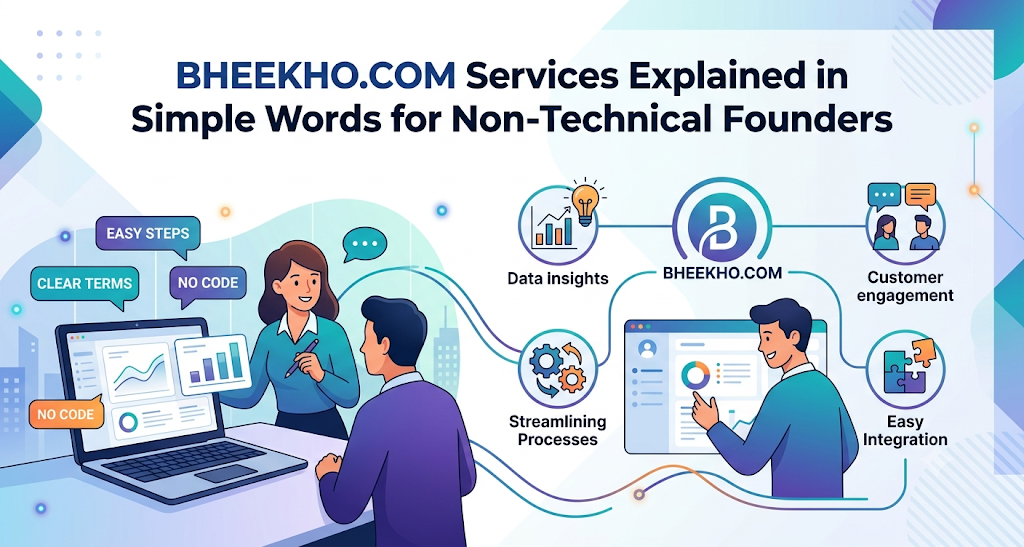
BHEEKHO.COM is dedicated to making technology accessible, understandable, and actionable for non-technical founders, growing businesses, and modern professionals. The platform acts as a guide for decision-makers who want to leverage digital innovation without getting lost in technical minutiae.
Rather than treating technology as an isolated discipline, BHEEKHO.COM focuses on practical utility and real-world execution. By bridging the gap between business strategy and digital tools, BHEEKHO.COM helps founders choose, implement, and optimize technology solutions that drive measurable business growth.
BHEEKHO.COM Services Explained in Simple Words
To help non-technical decision-makers make informed choices, let us examine the core service offerings and educational capabilities associated with BHEEKHO.COM, explained in clear, business-focused language.
Digital Transformation Advisory & Guidance
- What it means in simple words: Strategic guidance that helps you figure out which digital tools your business actually needs, which ones to eliminate, and how to organize them logically.
- Why your business needs it: Many companies end up using mismatched software tools that do not communicate with each other, leading to wasted subscription fees and duplicated effort.
- What problem it solves: Removes confusion around technology strategy, prevents wasted budgets on unnecessary tools, and creates a clear roadmap for your company’s digital upgrades.
- Practical situation: Imagine running a retail business using separate physical paper logs, spreadsheets for inventory, and a standalone card reader. Advisory guidance helps you connect these moving parts into a unified digital system where a single sale automatically updates inventory, logs accounting data, and records customer information.
Business Process Automation Learning & Implementation
- What it means in simple words: Teaching teams how to use software tools to handle repetitive, rule-based tasks automatically, eliminating the need for manual intervention.
- Why your business needs it: Manual data copying, paper invoice processing, and manual appointment scheduling consume valuable hours that your staff could spend growing the business.
- What problem it solves: Eliminates human copy-paste errors, speeds up day-to-day operations, and lowers operational costs.
- Practical situation: When a new lead submits a contact form on your website, an automated system immediately creates a record in your customer database, assigns a task to a salesperson, and sends a personalized welcome email to the lead within seconds.
Technology Skill Development & Team Upskilling
- What it means in simple words: Practical training designed to help founders and operational employees confidently master the digital platforms and software tools their business relies on.
- Why your business needs it: Advanced business software is useless if your workforce lacks the confidence or training to use it effectively.
- What problem it solves: Reduces internal resistance to new technology, shortens employee onboarding times, and ensures your company gets maximum ROI from its software subscriptions.
- Practical situation: Instead of leaving your customer support team to guess how a new helpdesk platform works, structured training equips them to resolve customer tickets faster and navigate the software with ease.
Digital Strategy for Growth & Scaling
- What it means in simple words: Planning how your digital architecture should evolve as your customer base, transaction volume, and operational headcount grow.
- Why your business needs it: Systems designed for 50 local clients often slow down or crash when handling 5,000 global customers.
- What problem it solves: Prevents service disruptions, system slowdowns, and costly last-minute technology replacements during periods of rapid business expansion.
- Practical situation: A growing e-commerce company plans its technology architecture ahead of time so its website remains fast, responsive, and secure during high-traffic holiday sales promotions.
How Technology Solutions Support Different Business Stages
Every company faces different operational priorities depending on its stage of growth. Digital tools should always be tailored to match your current scale and goals.
For New Entrepreneurs
When launching a venture, speed, flexibility, and cost control are top priorities:
- Establishing a professional digital web presence to build market credibility.
- Setting up basic cloud storage so team members can share documents securely from anywhere.
- Implementing simple payment processing tools to collect revenue without delay.
- Choosing flexible software subscriptions that can easily grow alongside your business.
For Growing Startups
As customer volume increases, manual processes start to break down:
- Connecting separate business systems so customer information flows seamlessly between sales, support, and billing teams.
- Automating routine communications to keep leads engaged without overworking your staff.
- Centralizing operational data into clear business dashboards for real-time performance tracking.
- Standardizing team workflows so new hires can quickly get up to speed.
For Established Businesses
For mature organizations, efficiency, security, and process optimization become paramount:
- Modernizing outdated systems to keep pace with changing market expectations.
- Eliminating operational bottlenecks across departments to improve overall margins.
- Enhancing cybersecurity measures to safeguard valuable company and customer data.
- Utilizing data insights to identify new revenue streams and optimize business models.
Traditional Business Processes vs. Digital Business Solutions
Comparing traditional paper-and-spreadsheet workflows with modern technology solutions illustrates the operational impact of digital tools:
| Business Area | Traditional Approach | Technology-Enabled Approach |
| Customer Management | Paper notebooks, physical business cards, or fragmented personal spreadsheets. | Centralized database accessible to authorized team members, updating interactions in real time. |
| Data Management | Static files stored on individual desktop computers with manual backup routines. | Secure cloud storage accessible anywhere with automated, redundant data backups. |
| Repetitive Tasks | Staff manually re-keying invoice details, customer addresses, and order information. | Software integrations that pass data across systems instantly without human intervention. |
| Team Communication | In-person meetings and long email chains where critical details easily get buried. | Organized digital messaging channels with integrated project management tracking. |
| Business Reporting | End-of-month manual accounting updates taking days or weeks to assemble. | Live reporting dashboards showing sales figures, margins, and customer metrics updated automatically. |
| Business Growth | Hiring additional administrative staff for every incremental increase in order volume. | Scaling processing capacity using software, allowing revenue to grow faster than operational overhead. |
| Decision Making | Relying on intuition or historical data that may already be weeks out of date. | Using real-time operational data to guide strategy, marketing spend, and inventory choices. |
Essential Technical Terms Explained Simply
Understanding basic technology concepts makes communicating with developers, software vendors, and technical partners much easier. Here are essential terms explained in plain business language:
- Digital Transformation: Updating how your company operates by adopting modern digital tools to deliver better value to your customers and lower operational costs.
- Business Automation: Setting up software rules to perform repetitive tasks automatically, saving your team time and eliminating manual errors.
- Cloud Technology: Storing files, running software, and managing data over secure internet servers instead of relying on local office hard drives.
- Software as a Service (SaaS): Renting software via a monthly or annual subscription over the internet, rather than purchasing physical installation media.
- API (Application Programming Interface): A digital bridge that allows two distinct software programs to share information automatically.
- Integration: Connecting different digital platforms (like your online shop and accounting software) so they work together smoothly.
- Data Analytics: Examining raw business figures to discover actionable trends, customer preferences, and operational opportunities.
- User Experience (UX): How intuitive, fast, and pleasant it is for a customer or employee to navigate your website or software platform.
- Cybersecurity: Security protocols, tools, and best practices designed to protect your company’s systems, devices, and data from unauthorized access.
- Scalability: The ability of your digital tools and infrastructure to easily handle increased work volume without breaking or requiring a complete redesign.
- Artificial Intelligence (AI): Software systems trained to spot patterns, analyze data, or generate content to help speed up complex human tasks.
- CRM (Customer Relationship Management): A organized digital system designed to track all client communications, sales progress, and service histories in one place.
How to Know Whether a Technology Investment Is Worth It
Before committing financial resources to new software, platforms, or technical consultants, non-technical founders should evaluate prospective tools against clear business criteria:
- Does it address a specific operational problem? Avoid adopting new tools simply because they are popular in tech headlines. Ensure the solution addresses a concrete bottleneck in your business.
- Will it save measurable staff time? Calculate how many hours per week the software will save your team. Compare the value of that reclaimed time against the subscription or implementation cost.
- Will it improve customer satisfaction? Determine if the tool will speed up delivery times, improve support quality, or make purchasing easier for your customers.
- Is it easy for your workforce to learn? Complex tools that your team finds confusing will end up underutilized, resulting in wasted software expenditure.
- Can it adapt as your company grows? Ensure the software can easily accommodate more user accounts, higher transaction limits, and expanded features as your business scales.
- Does it integrate with your current setup? Verify that the new software can share data cleanly with your existing tools, avoiding isolated information silos.
Common Technology Mistakes Founders Should Avoid
Steering clear of frequent digital pitfalls saves your business time, capital, and frustration:
+-----------------------------------------------------------------------+
|                      COMMON FOUNDER TECH MISTAKES                     |
+-----------------------------------------------------------------------+
| 1. Purchasing complex enterprise software when simple tools will do.  |
| 2. Adopting new platforms without training internal team members.     |
| 3. Managing customer records in disconnected personal spreadsheets.   |
| 4. Delaying basic cybersecurity measures like 2FA and backups.        |
| 5. Selecting tools that cannot connect or share data with each other. |
+-----------------------------------------------------------------------+
- Over-engineering Early Solutions: Buying enterprise-tier platforms when simple, off-the-shelf software would handle your current volume perfectly fine.
- Neglecting Team Onboarding: Investing heavily in software while failing to train employees on how to use it effectively.
- Operating in Data Silos: Allowing different departments to use isolated tools that cannot share data, forcing staff to re-enter information manually.
- Overlooking Security Hygiene: Using weak passwords, sharing login credentials, or skipping two-factor authentication on critical business accounts.
- Choosing Price Over Product Fit: Opting for the cheapest software option without verifying if it actually meets your operational requirements.
A Step-by-Step Guide to Working With a Technology Partner
Collaborating with digital consultants or technical specialists does not have to be intimidating. Follow this straightforward process to keep projects on track and aligned with your business goals:
Step 1: Define the Business Need
   │    Identify the exact operational pain point or outcome you want to address.
   ▼
Step 2: Translate to Desired Outcomes
   │    Specify measurable goals (e.g., "Cut customer response times in half").
   ▼
Step 3: Explore Suitable Options
   │    Review non-technical explanations of candidate tools, costs, and tradeoffs.
   ▼
Step 4: Establish Transparent Timelines & Costs
   │    Agree on fixed deliverables, setup expenses, and recurring subscription costs.
   ▼
Step 5: Roll Out in Phases
   │    Deploy core capabilities first, gather feedback, and refine as needed.
   ▼
Step 6: Train Team Members
   │    Ensure every user feels confident navigating the new digital workflow.
   ▼
Step 7: Measure Business Impact
        Evaluate performance against initial goals and optimize parameters over time.
- Define the Business Need: Clearly state the operational challenge you are facing (e.g., “Our invoice processing takes too long and leads to payment delays”).
- Focus on Desired Outcomes: Express what success looks like in simple business terms (e.g., “We want clients to receive invoices automatically and pay within 48 hours”).
- Review Practical Options: Ask your partner to explain candidate tools, costs, and implementation schedules in plain English without technical jargon.
- Confirm Complete Costs: Ensure you understand setup costs, subscription fees, and any ongoing maintenance expenses before signing agreements.
- Roll Out in Phased Stages: Implement core features first to validate the solution before adding complex advanced capabilities.
- Conduct Team Training: Schedule practical training sessions so employees understand how the new tools simplify their daily tasks.
- Track Return on Investment: Review performance after 30 to 90 days to verify that the solution is saving time and meeting your initial operational targets.
How BHEEKHO.COM Supports Non-Technical Founders
Navigating technology choices alone often leads to trial-and-error spending. BHEEKHO.COM provides structured guidance to help business owners make informed, cost-effective digital decisions.
BHEEKHO.COM supports non-technical leadership by:
- Demystifying Industry Buzzwords: Translating complex technology concepts into straightforward, actionable business insights.
- Providing Objective Guidance: Helping you evaluate software options based on practical utility, cost efficiency, and business alignment.
- Developing Digital Competency: Empowering founders and their teams with practical skills to run digital tools confidently.
- Focusing on Business Value: Ensuring every technology decision directly supports measurable goals like saving time, cutting costs, or increasing sales.
Why a Business-Focused Technology Approach Matters
There is a fundamental difference between building technology for its own sake and implementing digital tools to solve business problems.
+-------------------------------------------------------------------------------+
|                      TECH-FIRST vs. BUSINESS-FIRST APPROACH                   |
+-------------------------------------------------------------------------------+
| TECH-FIRST:     Chasing trendy features ──► High Complexity ──► Frustrated Team|
|                                                                               |
| BUSINESS-FIRST: Clear Operational Goal ──► Simple Tool ──► Higher Margins     |
+-------------------------------------------------------------------------------+
A technology-first approach focuses primarily on complex tools, underlying code, and the latest industry trends. This often leads to over-engineered solutions that are difficult to manage and yield poor returns on investment.
A business-first approach starts with your operational priorities:
- What manual tasks are slowing down your staff?
- Where are prospective clients dropping off in your sales funnel?
- How can you improve profit margins without sacrificing product quality?
By starting with these business questions, technology choices become clear. Digital tools are selected solely because they provide direct, measurable answers to operational needs.
Practical Real-World Scenarios
To see how modern digital tools assist non-technical founders, let us examine four realistic operational scenarios:
Scenario 1: A Small Business Managing Customers Manually
- The Operational Problem: A boutique consulting firm tracks client notes, active proposals, and billing schedules in separate physical notebooks and spreadsheets. Important follow-up dates get missed, and team members frequently misplace client details.
- The Digital Solution: The firm moves to a simple, centralized customer management system. All lead interactions, project notes, and contract dates are organized in one accessible space.
- The Business Outcome: The team recovers missed follow-ups, closes more proposals, and saves several hours a week on administrative organization.
Scenario 2: A Growing Team Spent on Repetitive Data Entry
- The Operational Problem: An e-commerce brand manually copies customer order details from their online store into an offline shipping spreadsheet and accounting ledger.
- The Digital Solution: The founder connects the online storefront directly to shipping software and cloud accounting tools via automated integrations.
- The Business Outcome: Order processing time drops from hours to minutes, shipping errors are eliminated, and staff can focus on marketing and customer service.
Scenario 3: A Service Business Struggling With Fragmented Data
- The Operational Problem: A home service company stores customer details on one platform, worker schedules on a separate whiteboard, and invoicing on a third tool. The founder spends every evening organizing data across systems.
- The Digital Solution: The business implements a unified scheduling and billing platform where job bookings automatically sync with worker calendars and issue digital invoices upon completion.
- The Business Outcome: Evening administrative work is reduced, invoices are sent instantly, and cash flow improves.
Scenario 4: A Business Preparing to Scale Operations
- The Operational Problem: A training academy manages student sign-ups, course materials, and certificates manually via email attachments. They want to double student enrollment next quarter but cannot handle the extra manual workload.
- The Digital Solution: The academy sets up a streamlined digital learning platform that automates student enrollment, delivers course resources online, and issues completion certificates automatically.
- The Business Outcome: Student capacity expands tenfold without adding administrative headcount, significantly boosting profit margins.
Frequently Asked Questions (FAQ)
What services does BHEEKHO.COM provide?
BHEEKHO.COM provides educational resources, digital transformation guidance, business technology strategies, and upskilling content designed to help founders and teams use digital tools effectively.
Is BHEEKHO.COM suitable for non-technical founders?
Yes. BHEEKHO.COM is specifically designed to translate complex technical concepts into clear, practical business language for founders without a technical background.
How can digital tools help a small business?
Digital tools automate repetitive tasks, reduce human error, centralize customer records, speed up service delivery, and make operations easier to scale efficiently.
Why do startups need digital business solutions?
Startups need efficient systems to handle rapid growth, keep operational costs manageable, and serve expanding customer bases without requiring immediate, massive hiring hires.
What is digital transformation in simple words?
Digital transformation means updating your business workflows with modern software tools to make operations faster, cheaper, and more convenient for your customers.
What is business automation?
Business automation uses software rules to handle routine, repetitive tasks automatically—such as sending receipt emails or updating inventory—without requiring manual input.
How can technology reduce manual work for my team?
By connecting your software tools so they pass data to each other automatically, eliminating the need for employees to manually copy and paste information between systems.
Why is scalable technology important for growing companies?
Scalable technology allows your software and systems to effortlessly manage higher sales volumes, more website traffic, and added customer requests without slowing down or crashing.
How should a founder choose the right software solution?
Identify your specific business challenge first, calculate potential time or cost savings, choose user-friendly tools that integrate with your existing setup, and start with a simple implementation.
What should a non-technical founder ask a technology partner?
Ask your partner to explain recommendations in plain English, provide total upfront cost breakdowns, detail the onboarding timeline, and demonstrate how the software will directly impact your operational efficiency.
How do digital solutions improve customer experience?
Digital solutions speed up communication response times, simplify payment processing, offer self-service options, and ensure customer service teams have immediate access to complete account histories.
How can a traditional business prepare for digital upgrades?
Start by identifying your most time-consuming manual processes, organizing your existing customer records digitally, upskilling your team, and implementing simple, high-impact software tools one step at a time.
Conclusion
Building a successful company does not require writing code or mastering complex software architecture. As a founder, your primary focus should always remain on strategic leadership, serving your target audience, and driving business growth. Technology is simply a practical tool to help you achieve those goals faster, more reliably, and at a larger scale.
Choosing the right digital solutions comes down to focusing on clear business outcomes: saving team hours, reducing manual errors, improving client satisfaction, and increasing profit margins. By working with a business-focused partner like BHEEKHO.COM, non-technical founders can confidently navigate digital choices, adopt modern software tools, and build resilient, scalable businesses.

