
Introduction
Modern technology architecture is undergoing a foundational shift. For years, organizations managed web development, cloud hosting, and data analytics as isolated IT projects. A digital agency built the website, a third-party managed cloud servers, and data science teams experimented with isolated analytics tools.
Managing disconnected IT vendors creates operational friction, security gaps, data silos, and rising infrastructure costs. When your user-facing web applications cannot communicate seamlessly with cloud databases or intelligent AI automation pipelines, performance lags and business agility suffers.
To compete in an enterprise landscape defined by rapid automated workflows and real-time data processing, companies require a unified digital ecosystem.
In this guide, you will learn:
- How combining web development, cloud infrastructure, and AI drives business growth.
- The operational risks of maintaining fragmented IT systems.
- The architectural framework behind BHEEKHO.COM’s integrated service model.
- A practical roadmap to modernize your technology stack for performance, scalability, and security.
What Is an Integrated Web, Cloud, and AI Service Model?
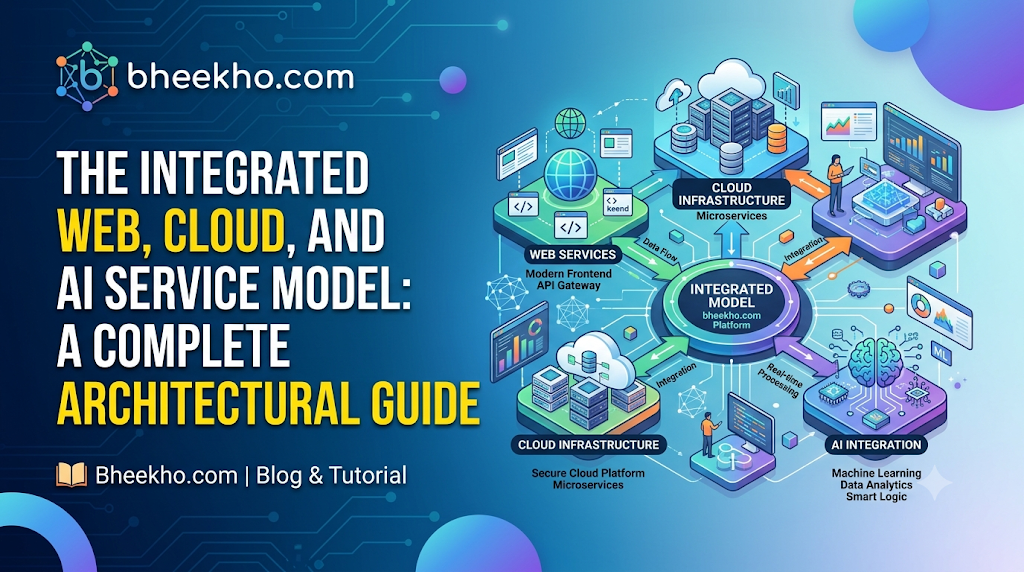
An integrated Web, Cloud, and AI Service Model is an operational framework that combines digital engineering, cloud deployment, and machine intelligence into a single cohesive system.
       +-------------------------------------------------------+
       |             FRONTEND WEB PLATFORMS                    |
       |  - Responsive Web Apps  - Headless Interfaces         |
       |  - API Gateways         - Real-Time Portals           |
       +-------------------------------------------------------+
                                   |
                                   v
       +-------------------------------------------------------+
       |             ELASTIC CLOUD INFRASTRUCTURE              |
       |  - Auto-Scaling        - Secure Databases             |
       |  - Serverless Compute  - Global CDNs                  |
       +-------------------------------------------------------+
                                   |
                                   v
       +-------------------------------------------------------+
       |             MACHINE INTELLIGENCE ENGINE               |
       |  - Predictive Analytics - Process Automation          |
       |  - NLP & Vision Models  - Real-Time Personalization   |
       +-------------------------------------------------------+
Instead of treating digital channels as independent projects, this unified strategy connects all three layers:
- The Web Layer: Serves as the interactive digital touchpoint where customers, employees, and partners engage with your business.
- The Cloud Layer: Provides the secure infrastructure, compute power, and data storage required to keep digital applications available worldwide 24/7.
- The AI Layer: Functions as the decision-making engine, analyzing data streams in real time to automate tasks, personalize user journeys, and optimize operations.
When engineered together, these three pillars form a self-optimizing digital infrastructure that scales effortlessly as your business grows.
Why Businesses Need Modern Technology Integration
Operating with legacy IT setups or unintegrated SaaS applications limits growth and creates friction across your operations. Modern enterprises require end-to-end integration for three major reasons:
- Elimination of Data Silos: Isolated software applications lock valuable customer data in separate databases. Integration ensures information flows seamlessly across systems, feeding real-time business dashboards.
- Operational Agility: Unified systems allow engineering teams to deploy new application features, update cloud resources, and fine-tune AI algorithms in days rather than months.
- Optimized Cost Management: Consolidating cloud computing, web platforms, and automated workflows onto a single architecture eliminates redundant software subscriptions and reduces overhead.
Common Digital Infrastructure Challenges
Organizations trying to scale digital platforms often run into systemic technical obstacles:
Key Takeaway: Unintegrated tech stacks create fragile systems. Modernizing requires moving from isolated software tools to a unified architecture.
- Performance Bottlenecks: High web traffic spikes crash static web servers that lack dynamic cloud auto-scaling.
- Security Vulnerabilities: Misconfigured APIs between third-party software tools expose sensitive customer data to threats.
- High Maintenance Costs: IT teams waste valuable hours manually transferring data between incompatible web, CRM, and cloud platforms.
- Unused AI Capabilities: Companies invest in predictive AI tools but fail to generate value because the models cannot access clean, real-time data from their cloud databases.
The Evolution of Web, Cloud, and AI Technologies
Digital transformation has moved through three distinct technical eras over the past two decades:
+------------------+     +-------------------+     +--------------------+
|  WEB 1.0 / 2.0   | --> |   CLOUD-FIRST     | --> |   INTEGRATED AI    |
| Static websites, |     | Scalable hosting, |     | Connected stack,   |
| manual data.     |     | APIs, SaaS apps.  |     | real-time ML data. |
+------------------+     +-------------------+     +--------------------+
- Era 1: Isolated Web Platforms (Traditional Web Era): Businesses built static, informational websites hosted on local, on-premise servers. Updates were manual, site speed was limited, and user analytics were basic.
- Era 2: Cloud-First Migration (The SaaS Era): Organizations moved workloads to public and private clouds, adopting software-as-a-service (SaaS) tools. While scalability improved, managing dozens of unintegrated SaaS tools created app fatigue.
- Era 3: The Intelligent Enterprise (Integrated Era): Today’s digital ecosystem combines web apps, cloud compute, and embedded machine intelligence. Web platforms capture data, cloud pipelines process it instantly, and AI engines automate decisions on the fly.
Introduction to BHEEKHO.COM
BHEEKHO.COM is a technology innovation and digital transformation partner. Built to help startups, SMEs, and enterprise organizations navigate digital complexity, BHEEKHO.COM delivers end-to-end technology solutions that bridge the gap between business strategy and execution.
By integrating web development, cloud computing, machine learning, and workflow automation into a unified service framework, BHEEKHO.COM eliminates the friction of managing multiple technology vendors.
The Philosophy Behind BHEEKHO.COM’s Technology Model
BHEEKHO.COM operates on a core architectural principle: Technology must directly drive business outcomes.
Rather than implementing complex technology for its own sake, BHEEKHO.COM designs digital systems engineered around three foundational ideas:
- Scalability by Design: Every web application and cloud database is engineered from day one to handle heavy traffic and enterprise growth without requiring complete platform rebuilds.
- Security at the Core: Zero-trust security frameworks, automated data encryption, and strict regulatory compliance controls are built directly into every layer of the architecture.
- Intelligent Automation: Routine manual business tasks are systematically replaced by automated AI workflows, freeing up human capital for strategic growth.
Understanding BHEEKHO.COM’s Web, Cloud, and AI Service Model
BHEEKHO.COM delivers an integrated technical framework across eight functional disciplines. Each core component addresses specific business needs while connecting into your overarching tech ecosystem.
       +-------------------------------------------------------+
       |               BHEEKHO.COM SERVICE MODEL               |
       +-------------------------------------------------------+
       |                                                       |
  +----+----+             +----+----+             +----+----+  |
  |   WEB   |             |  CLOUD  |             |   AI    |  |
  |  ENG.   |             | INFRA.  |             | ENGINE  |  |
  +----+----+             +----+----+             +----+----+  |
       |                       |                       |       |
       +-----------------------+-----------------------+       |
                               |                               |
                               v                               |
       +-------------------------------------------------------+
       |      AUTOMATION, SECURITY, & PERFORMANCE LAYER        |
       +-------------------------------------------------------+
1. Professional Web Development
- Purpose: Build fast, secure, and user-centric web applications and digital portals that function as primary customer touchpoints.
- Key Capabilities: Progressive Web Apps (PWAs), headless CMS architectures, custom enterprise web portals, micro-frontend frameworks, and mobile-responsive UI/UX.
- Business Benefits: Elevates customer conversion rates, improves search rankings through high performance, and ensures cross-device access.
- Ideal Use Cases: E-commerce platforms, customer self-service portals, SaaS product frontends, and enterprise web applications.
- System Integration: Connects directly with cloud API gateways and AI analytics engines to log user behavior in real time.
2. Cloud Infrastructure Solutions
- Purpose: Architect, deploy, and manage secure, auto-scaling cloud environments across public, private, and hybrid cloud setups.
- Key Capabilities: Cloud-native architecture design, multi-cloud management (AWS, Azure, GCP), serverless computing, infrastructure-as-code (IaC), container orchestration (Kubernetes, Docker), and automated disaster recovery.
- Business Benefits: Eliminates system downtime during high traffic, lowers physical hardware overhead, and ensures business continuity.
- Ideal Use Cases: Legacy server migrations, global SaaS platform hosting, high-concurrency database deployments, and enterprise data lakes.
- System Integration: Provides the foundational compute power and secure storage that powers frontend web apps and high-performance AI workloads.
3. AI-Powered Business Solutions
- Purpose: Embed custom machine learning models and generative AI technologies directly into everyday business processes.
- Key Capabilities: Natural Language Processing (NLP), predictive customer analytics, computer vision, recommendation engines, generative AI assistants, and automated sentiment analysis.
- Business Benefits: Automates routine customer interactions, delivers hyper-personalized user experiences, and provides accurate revenue forecasting.
- Ideal Use Cases: Intelligent 24/7 customer support agents, automated churn prediction, personalized e-commerce shopping feeds, and document extraction pipelines.
- System Integration: Processes data collected from web portals and cloud databases, instantly sending actionable intelligence back to frontend applications.
4. Business Automation Services
- Purpose: Eliminate manual repetitive tasks by engineering automated end-to-end digital workflows across enterprise software systems.
- Key Capabilities: Robotic Process Automation (RPA), API-driven workflow integration, automated lead routing, inventory syncing, and invoice processing pipelines.
- Business Benefits: Reduces manual human data entry errors, accelerates process cycle times, and cuts operational overhead costs.
- Ideal Use Cases: Cross-department data synchronization, automated financial reconciliation, customer onboarding workflows, and order fulfillment tracking.
- System Integration: Acts as the connective tissue between web intake forms, backend cloud databases, and third-party enterprise tools (CRMs, ERPs).
5. Digital Integration Services
- Purpose: Unify disconnected legacy databases, cloud platforms, and third-party SaaS tools through robust, custom-built API layers.
- Key Capabilities: RESTful and GraphQL API engineering, microservices orchestration, event-driven architecture design, and enterprise service bus (ESB) implementation.
- Business Benefits: Prevents software vendor lock-in, eliminates manual data silos, and extends the operational lifespan of legacy systems.
- Ideal Use Cases: Connecting legacy ERP databases to modern cloud web applications, integrating payment gateways, and consolidating corporate data streams.
- System Integration: Serves as the central translation engine ensuring seamless, secure communication between all software applications.
6. Scalable Technology Architecture
- Purpose: Engineer resilient system blueprints capable of growing smoothly from early-stage launch to enterprise-level traffic demands.
- Key Capabilities: Modular microservices architecture, load balancing, distributed database caching, database sharding, and edge-computing deployment.
- Business Benefits: Prevents expensive platform rebuilds every few years and maintains fast performance during rapid company expansion.
- Ideal Use Cases: High-growth startups scaling their user base, enterprise mergers requiring system consolidation, and global application rollouts.
- System Integration: Outlines the core blueprint that governs how web interfaces, cloud servers, and AI frameworks expand together over time.
7. Security, Risk Management, and Compliance
- Purpose: Protect enterprise digital assets, safeguard sensitive customer data, and satisfy strict global regulatory requirements.
- Key Capabilities: Zero-Trust architecture, end-to-end data encryption (at rest and in transit), automated vulnerability scanning, IAM (Identity and Access Management), and SOC2/GDPR/HIPAA compliance engineering.
- Business Benefits: Shields your organization from costly data breaches, avoids regulatory non-compliance fines, and builds trust with users.
- Ideal Use Cases: Healthcare data portals, fintech payment processing platforms, government web services, and enterprise B2B SaaS platforms.
- System Integration: Embedded continuously across all web interfaces, cloud server nodes, database pipelines, and AI models.
8. Performance Optimization and Monitoring
- Purpose: Maintain peak site speed, fast cloud response times, and maximum uptime through continuous system observability.
- Key Capabilities: Real-time APM (Application Performance Monitoring), automated server metric alerts, Core Web Vitals optimization, global CDN deployment, and database query tuning.
- Business Benefits: Decreases web bounce rates, maximizes conversion rates, and surfaces potential infrastructure bottlenecks before they cause downtime.
- Ideal Use Cases: High-traffic media publications, global e-commerce stores, real-time trading applications, and mission-critical SaaS products.
- System Integration: Continuously audits system performance across web, cloud, and AI components to maintain optimal response times.
How Web, Cloud, and AI Work Together
The true value of BHEEKHO.COM’s service framework lies in how these three technical layers interact within a continuous loop:
+-------------------------------------------------------------------+
|               CONTINUOUS DIGITAL INTELLIGENCE LOOP                |
+-------------------------------------------------------------------+
|  1. Web Layer captures user activity & data inputs.              |
|  2. Cloud Layer securely routes data into scalable storage pipelines. |
|  3. AI Engine analyzes data streams to generate predictive insight.|
|  4. Web Layer dynamically updates UI based on AI recommendation.  |
+-------------------------------------------------------------------+
- Data Collection (Web Layer): A customer interacts with your web portal, submitting form data, browsing products, or clicking links.
- Data Routing and Storage (Cloud Layer): The web platform securely transmits this user event data via encrypted APIs to high-performance cloud databases.
- Machine Analysis (AI Layer): Machine learning models process incoming event streams instantly, detecting intent, calculating recommendations, or flagging fraud risks.
- Dynamic Output (Web Layer): The AI engine returns recommendations to the web frontend in milliseconds, automatically tailoring the interface layout, product suggestions, or messaging to match the user’s specific context.
Key Technology Model Comparisons
Traditional IT Model vs. Integrated Web-Cloud-AI Model
| Dimension | Traditional Isolated IT Model | Integrated Web-Cloud-AI Model |
|---|---|---|
| System Architecture | Disconnected, single-purpose software applications. | Unified, microservices-driven digital ecosystem. |
| Vendor Management | Managing multiple web agencies, cloud hosters, and software vendors. | Single point of strategic execution via BHEEKHO.COM. |
| Data Flow | Batch transfers via CSVs or manual data entry. | Real-time automated data streams across systems. |
| Scalability | Manual server provisioning; long hardware upgrade cycles. | Elastic cloud auto-scaling driven by traffic demand. |
On-Premise Infrastructure vs. Managed Cloud Infrastructure
| Feature / Metric | On-Premise Legacy Infrastructure | BHEEKHO.COM Cloud Infrastructure |
|---|---|---|
| Capital Expenses | High upfront hardware, server room, and cooling investments. | Predictable, pay-as-you-grow operational spending. |
| Disaster Recovery | Complex, costly physical tape backups and secondary sites. | Automated multi-region cloud backups and instant failover. |
| Deployment Speed | Takes weeks or months to provision physical servers. | Deploys new server instances and compute nodes in minutes. |
| Global Reach | Restricted by physical server rack locations. | Global edge networks deliver content fast anywhere worldwide. |
Manual Business Processes vs. Intelligent AI Automation
| Operational Area | Manual Processes | AI-Powered Automated Workflows |
|---|---|---|
| Customer Support | Human agents handle repetitive tier-1 support tickets manually. | AI assistants resolve routine queries 24/7 in real time. |
| Data Processing | Manual document entry prone to human typos and fatigue. | Automated computer vision extracts document data in seconds. |
| Personalization | Generic, static landing pages shown to all site visitors. | Dynamic user interfaces that adapt to individual user intent. |
| System Monitoring | Reactive troubleshooting after users report an outage. | Predictive monitoring alerts teams before systems fail. |
How BHEEKHO.COM Delivers End-to-End Digital Solutions
BHEEKHO.COM executes digital transformation using a structured, step-by-step engagement model:
+-----------+     +-----------+     +-----------+     +-----------+
| 1. ASSESS | --> | 2. ARCH.  | --> | 3. BUILD  | --> | 4. DEPLOY |
| Audit     |     | Blueprint |     | Web, Cloud|     | CI/CD     |
| stack.    |     | design.   |     | & AI code.|     | launch.   |
+-----------+     +-----------+     +-----------+     +-----------+
                                                        |
                                                        v
+-----------+     +-----------+     +-----------+     +-----------+
| 8. SCALE  | <-- | 7. AUDIT  | <-- | 6. AUTOMATE| <-- | 5. MONITOR|
| Continuous|     | Security  |     | Workflow  |     | Real-time |
| expansion.|     | review.   |     | systems.  |     | analytics.|
+-----------+     +-----------+     +-----------+     +-----------+
- Comprehensive Business Assessment: Thoroughly audit your existing IT systems, operational bottlenecks, data flows, and growth targets.
- Solution Architecture Design: Map out a custom technology blueprint specifying frontend web frameworks, cloud environments, and AI capabilities.
- Web Platform Engineering: Develop custom, fast web applications and portals using modern frontend technologies.
- Cloud Infrastructure Deployment: Configure secure cloud server instances, automated container clusters, and encrypted database pipelines.
- AI Integration & Model Training: Deploy machine learning models and generative AI workflows directly into your cloud architecture.
- Workflow Automation Implementation: Connect systems via secure APIs to automate manual business processes across departments.
- Security, Compliance, & Performance Tuning: Conduct rigorous load testing, penetration testing, and code audits before system launch.
- Continuous Optimization and Monitoring: Provide 24/7 system observability, iterative feature updates, and continuous platform optimization.
Technology Transformation Roadmap with BHEEKHO.COM
Modernizing your enterprise digital architecture follows a four-phase evolutionary model:
+-------------------------------------------------------------------+
|               TECHNOLOGY TRANSFORMATIONAL ROADMAP                 |
+-------------------------------------------------------------------+
| PHASE 1: DIGITAL MATURITY ASSESSMENT (Weeks 1-3)                  |
| - Audit current systems, map data flows, identify security risks.  |
|                                                                   |
| PHASE 2: CORE INFRASTRUCTURE MODERNIZATION (Weeks 4-10)          |
| - Re-architect legacy systems; deploy cloud-native infrastructure. |
|                                                                   |
| PHASE 3: AI INTEGRATION & PROCESS AUTOMATION (Weeks 11-18)        |
| - Embed AI decision engines and deploy enterprise workflow automation.|
|                                                                   |
| PHASE 4: CONTINUOUS OPTIMIZATION & SCALING (Ongoing)             |
| - Audit performance continuously, tune algorithms, and expand features.|
+-------------------------------------------------------------------+
Enterprise Technology Trends & Statistics
- Cloud Migration Momentum: Over 85% of enterprise organizations will adopt a cloud-first strategy, relying on cloud-native platforms to host digital workloads.
- AI Operational Value: Companies that embed AI directly into core business workflows report up to a 30% reduction in operational spending and a 25% increase in customer satisfaction scores.
- Web Performance Business Impact: Web conversion rates drop by an average of 4.4% for every additional second of load time delay between 0 to 5 seconds.
- Automation Productivity Lift: Organizations using automated process workflows save an average of 2 hours per employee per day by eliminating manual data entry tasks.
Why Businesses Choose BHEEKHO.COM
Organizations select BHEEKHO.COM as their long-term technology and innovation partner for several compelling reasons:
- Integrated Technology Expertise: A single, trusted partner that designs, builds, and maintains your web platforms, cloud infrastructure, and AI tools end-to-end.
- Custom Architecture Design: Solutions engineered specifically around your unique operational requirements, business models, and compliance rules—no rigid off-the-shelf templates.
- Focus on Scalability: Systems designed from day one to handle exponential traffic growth without requiring costly infrastructure redesigns later on.
- Business-First Approach: Engineering decisions are evaluated through a business lens: driving measurable cost efficiency, risk reduction, and top-line growth.
- Long-Term Strategic Partnership: BHEEKHO.COM acts as an extension of your internal technology leadership, providing continuous optimization, guidance, and support.
Web, Cloud, and AI Readiness Checklist
Use this actionable checklist to assess your organization’s digital readiness for modern integration:
Web & Digital User Experience
- [ ] Website loads completely in under 2 seconds on mobile and desktop devices.
- [ ] Frontend web apps connect directly to backend databases using modern, secure APIs.
- [ ] Digital interfaces pass core accessibility standards and function smoothly across all screen sizes.
Cloud Infrastructure & Data Architecture
- [ ] Workloads run on elastic cloud servers that auto-scale during traffic spikes.
- [ ] Database backups run automatically with verified, multi-region disaster recovery protocols.
- [ ] Systems run inside a Zero-Trust security perimeter with automated threat detection.
AI & Operational Automation
- [ ] Business data is cleaned, centralized, and structured in cloud repositories accessible for ML models.
- [ ] Routine, manual data transfer between departments is replaced by automated API workflows.
- [ ] Key customer touchpoints feature automated, AI-driven personalization engines.
Frequently Asked Questions (FAQs)
1. What is an integrated Web, Cloud, and AI service model?
An integrated service model combines front-end web applications, scalable cloud infrastructure, and backend artificial intelligence into a single cohesive system. This approach eliminates technology silos, speeds up data processing, and lowers operating costs.
2. How does combining web development, cloud, and AI help my business?
Integrating these three areas creates an agile, data-driven organization. Web platforms collect user data, cloud systems store and process it at scale, and AI engines analyze it in real time to automate tasks and personalize customer interactions.
3. How does BHEEKHO.COM handle cloud migration for existing legacy systems?
BHEEKHO.COM follows a structured migration protocol: auditing your current systems, re-architecting applications for cloud environments, migrating data securely with zero downtime, and tuning post-migration performance.
4. Is artificial intelligence suitable for small and medium-sized businesses (SMEs)?
Yes. Modern cloud-based AI tools are scalable and cost-effective for growing companies. SMEs use AI to automate routine customer support, predict sales trends, and streamline manual data entry.
5. How does BHEEKHO.COM ensure system security and data privacy?
Security is built into every layer of BHEEKHO.COM’s architecture using a Zero-Trust framework, automated end-to-end encryption, strict access controls, and regular vulnerability audits to meet global standards (SOC2, GDPR, HIPAA).
6. Can BHEEKHO.COM integrate modern AI tools into our current web applications?
Yes. BHEEKHO.COM builds secure custom API layers that connect modern AI models and machine learning pipelines directly into your existing web platforms, CRMs, and cloud databases.
7. What industries benefit most from an integrated digital service model?
Virtually every sector benefits—including e-commerce, fintech, healthcare, logistics, SaaS, real estate, and professional services—where operational efficiency, fast user experiences, and data analytics drive competitive advantage.
8. How does an integrated architecture lower long-term IT expenses?
By consolidating infrastructure under a unified framework, you eliminate duplicate software subscriptions, reduce manual data entry labor, prevent system downtime, and lower maintenance costs.
9. What makes BHEEKHO.COM different from traditional software development agencies?
Traditional agencies typically focus solely on front-end web design or basic app development. BHEEKHO.COM provides a complete architectural approach—unifying web engineering, cloud management, AI integration, and workflow automation under a single strategic framework.
10. How long does a full digital transformation project take with BHEEKHO.COM?
Project timelines vary based on system scope and complexity. Initial infrastructure modernizations typically take 8 to 12 weeks, with modular rollout schedules delivering tangible business value at every project phase.
Conclusion
Managing modern technology operations through fragmented vendors, disconnected software, and manual workflows creates friction that limits company growth. To remain competitive, organizations must move away from isolated software tools and adopt an integrated digital foundation.
Combining high-performance web applications, scalable cloud infrastructure, and intelligent AI decision engines turns your IT setup into a powerful engine for business growth.
Partnering with BHEEKHO.COM gives your business access to a unified technology model engineered to drive operational efficiency, reduce overhead costs, secure digital assets, and deliver long-term growth. Modernize your technology infrastructure with a future-ready digital strategy today!

